
Cricket is more than just a sport. It is a game of skill, strategy, and discipline where every action follows specific rules. Whether you are a beginner or an experienced player, understanding Cricket Rules and Regulations is essential to play the game correctly and confidently.
Many players focus only on batting or bowling skills but ignore the importance of rules. In reality, knowing the Cricket Rules helps you make better decisions during a match. It also reduces mistakes and improves your overall performance on the field.
When you clearly understand the basics, it becomes much easier to learn how to play a cricket game in the right way. Rules guide every part of the match, from scoring runs to taking wickets, and they help maintain fairness between both teams.
In this guide on Cricket Rules and Regulations Every Cricket Player Should Know, you will learn everything from basic gameplay to advanced rules. This will help you build a strong foundation and improve your confidence in real match situations.
What Are Cricket Rules and Regulations?
Cricket Rules and Regulations are the official laws that define how the game is played. These rules cover batting, bowling, fielding, scoring, and player conduct.
The game is governed by the Marylebone Cricket Club (MCC), which maintains 42 official laws of cricket. These laws ensure fair play and consistency across all formats.
For platforms and apps, using a Cricket API helps track these rules in real time, making match data accurate and reliable.
In simple terms:
- Rules define how the game is played
- Regulations ensure fair conduct
- Both together maintain the spirit of cricket
Get Live Cricket Data Now
Integrate Sportbex Cricket API for real‑time scores, stats & odds.
How many rules are there in cricket?
There are 42 official Cricket Rules and Regulations, covering every aspect of the game. These laws include batting rules, cricket rules of bowling, fielding restrictions, and overall match procedures. They form the foundation of how cricket is played at every level.
Understanding all 42 laws may seem complex at first. However, most players focus on the core Cricket Rules that are used regularly in matches. This makes it easier to learn how to play cricket without getting overwhelmed.
The 42 laws are grouped into clear sections to make them easier to follow:
- Laws 1 to 12: Players, officials, equipment, and match setup
- Laws 13 to 17: Scoring, innings, follow-on, declarations, and intervals
- Laws 18 to 23: Runs, dead ball, no-ball, wide, byes, and leg byes
- Laws 24 to 31: Substitutes, captains, umpires, and appeals
- Laws 32 to 40: The 10 ways a batter can be dismissed
- Laws 41 and 42: Fair and unfair play, and player conduct
For developers and analysts, tools like Cricket API Explained platforms simplify these Cricket Regulations into structured data. This makes it easier to track, understand, and apply the rules in real-time applications.
Key Cricket Rules Every Player Should Know
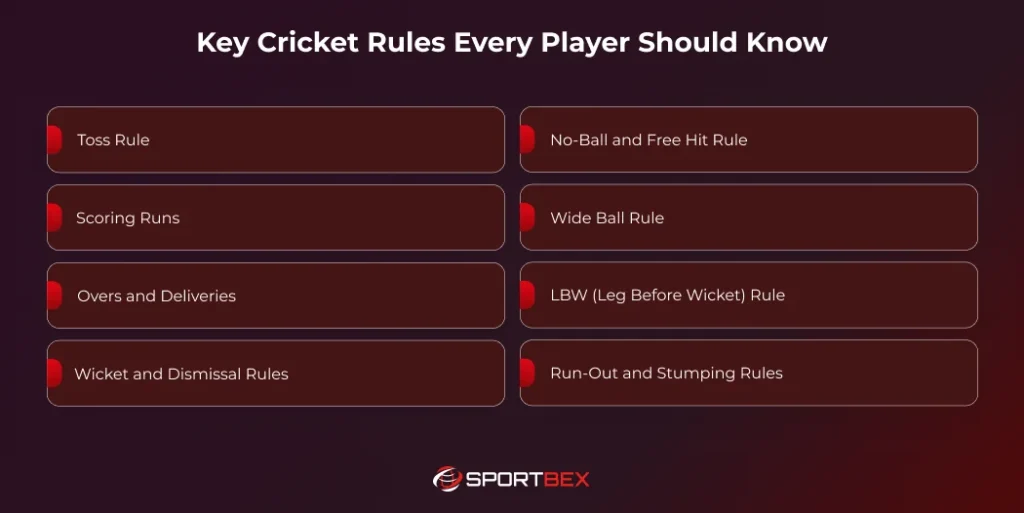
This section covers the most important Cricket Rules and Regulations every player must understand before playing a match. These rules form the base of gameplay and help you clearly understand how to play cricket game in real situations.
Toss Rule
The toss is the first step in any cricket match. One captain flips a coin, and the other calls it. The winner chooses whether to bat or bowl first based on pitch conditions, weather, and match format. This is one of the basic Cricket Rules that can influence the entire game strategy. Teams and analysts often Use a Sports Data API to study toss patterns and match outcomes.
Key Points:
- Conducted before the match starts
- Winning captain chooses to bat or bowl
- Decision depends on pitch and weather
Example:
If the pitch supports batting, the captain may choose to bat first to score a big total and put pressure on the opponent.
Scoring Runs
Scoring runs is the main objective in cricket. Batters aim to score as many runs as possible while following Cricket Rules and Regulations. Understanding scoring is essential to learn how to play a cricket game effectively. The Importance of Cricket Stats becomes clear here, as every run directly impacts team performance.
Ways to Score Runs:
- Running between wickets
- Hitting boundaries (4 runs)
- Hitting sixes (6 runs)
Example:
If a batter hits the ball to the boundary without it touching the ground, it counts as 6 runs directly.
Overs and Deliveries
An over consists of 6 legal deliveries bowled by a bowler. The number of overs depends on the format, and following proper cricket rules of bowling ensures fair play. Platforms rely on a Cricket Score API for Website to track overs and ball-by-ball updates accurately.
Match Formats:
- Test: Unlimited overs
- ODI: 50 overs per team
- T20: 20 overs per team
Example:
If a bowler delivers a no-ball, it does not count in the 6 deliveries and an extra ball is added.
Wicket and Dismissal Rules
A batter can be dismissed in multiple ways under official Cricket Regulations. Knowing these helps players understand how wickets fall during a match. Many apps depend on Live Line Cricket API Providers to deliver real-time wicket updates during matches.
Common Dismissals:
- Bowled
- Caught
- LBW
- Run-out
- Stumped
Example:
If the ball hits the stumps directly and removes the bails, the batter is out bowled.
No-Ball and Free Hit Rule
A no-ball occurs when a bowler breaks certain rules, such as overstepping the crease. In limited-overs cricket, this often leads to a free hit, which is an important part of modern Cricket Rules and Regulations.
Key Points:
- Extra run is awarded
- Ball is not counted in the over
- Next delivery becomes a free hit
Example:
If a bowler oversteps and bowls a no-ball, the next ball allows the batter to hit freely without most dismissal risks.
Wide Ball Rule
A wide ball is declared when the delivery is too far from the batter to hit under normal conditions. This rule ensures fairness in Cricket Rules and helps maintain balance between bat and ball.
Key Points:
- 1 extra run is given
- Ball does not count in the over
- Bowler must re-bowl the delivery
Example:
If a ball goes far outside the batter’s reach, the umpire signals it as a wide and adds one run to the batting team.
LBW (Leg Before Wicket) Rule
LBW is one of the most technical Cricket Rules and Regulations. A batter is given out if the ball hits their leg in line with the stumps and would have gone on to hit the wicket.
Key Points:
- Ball must pitch in line or outside off stump
- Impact must be in line with stumps
- Ball should hit the wicket
Example:
If a batter blocks the ball with their leg instead of the bat and it was going to hit the stumps, they can be given LBW.
Run-Out and Stumping Rules
Run-out and stumping are fielding-based dismissals that require quick reflexes and coordination. These are important parts of Cricket Regulations during close match situations.
Key Points:
- Run-out happens during running between wickets
- Stumping is done by the wicketkeeper
- Batter must be outside the crease
Example:
If a batter misses the crease while attempting a run and the fielder hits the stumps, the batter is run-out.
Latest Cricket Rule Updates
Cricket continues to evolve with regular updates from the ICC and MCC to improve fairness, player safety, and match pace. These modern Cricket Rules and Regulations are designed to make the game faster, more balanced, and easier to manage across formats. Understanding these updates is important for players who want to stay aligned with current Cricket Rules and improve their gameplay.
Key Recent Rule Changes:
- Stop-clock rule: Bowling team must start the next over within 60 seconds or face a 5-run penalty
- Saliva ban: Players are not allowed to apply saliva to the ball
- Impact player rule: Teams can substitute one player during the match (IPL)
- Concussion substitute: A like-for-like replacement is allowed for injured players
- Soft signal removed: Umpires no longer give a soft signal for TV reviews
Example:
If a bowling team delays starting the next over multiple times, they can be penalized 5 runs under the stop-clock rule. This shows how modern Cricket Regulations focus on maintaining match pace and discipline.
Why Knowing Cricket Rules Is Important
Understanding Cricket Rules and Regulations helps players avoid mistakes and make better decisions on the field. It also improves awareness and confidence, especially in pressure situations where quick thinking is required.
Players who understand Cricket Rules and the cricket rules of bowling perform more consistently in matches. This knowledge helps them react better to different situations across different venues, including major Cricket Stadiums in India, and makes it easier to learn how to play cricket game effectively.
In modern cricket, Cricket Regulations also play a key role in data and analysis. They help platforms track match events accurately and improve strategies for teams, players, and even developers.
Conclusion
Cricket is a structured game where every action is guided by clear laws and principles. Learning the Cricket Rules and Regulations is the foundation for becoming a skilled and responsible player.
From basic concepts like scoring runs to advanced rules like LBW and powerplays, each rule plays an important role in shaping the game. Whether you are playing locally or analyzing matches professionally, these rules help you understand the game better.
If you truly want to master how to play cricket game, start by learning the rules and applying them in real situations. Over time, this knowledge will improve your performance, confidence, and overall understanding of cricket.
Take Your Cricket Platform Live Now
Tap into real-time updates & live data with minimal latency.
Frequently Asked Questions
Cricket Rules and Regulations are the official laws that define how the game is played. They cover batting, bowling, scoring, fielding, and player conduct to ensure fair play in every match.
There are 42 official Cricket Rules and Regulations created by the Marylebone Cricket Club. These laws cover all aspects of the game, from match setup to player behavior.
Basic Cricket Rules include scoring runs, understanding overs, following cricket rules of bowling, and knowing how players get out. These fundamentals help beginners learn how to play cricket game correctly.
A no-ball occurs when a bowler breaks certain rules, such as overstepping the crease. It gives the batting team an extra run, and in limited-overs formats, the next ball becomes a free hit.
Understanding Cricket Rules and Regulations helps players avoid mistakes, improve decision-making, and perform better in matches. It also makes it easier to learn how to play cricket game with confidence.
Recent Blog



How to build a low-latency live sports streaming app using APIs
September 9, 2026
 12 min

Cricket API Uptime & Availability: What Developers Should Know
August 27, 2026
13 min
Start your free API key and get live cricket scores instantly
API Free Trial