Football has always been a game of skill, teamwork, and excitement. But in today’s era, the sport is also shaped by data. Coaches, analysts, and even fans now look closely at soccer player stats to understand how a match was played and what might happen next.
These soccer player stats show much more than just goals and assists, starting from simple soccer stats to more detailed performance metrics. They reveal how hard a player works, how often they create chances, how strong they are in defense, and how they move the ball across the pitch. This helps teams get a clear picture of each player’s role and impact.
By using soccer match analysis and soccer player performance analysis, clubs can study patterns, compare performances, and make smarter decisions for training, tactics, and upcoming games. This kind of information also helps us predict how a team or player might perform in the future.
In this blog, we’ll break down what player performance stats really mean, why football player statistics matter so much today, and how these numbers help us understand and predict match outcomes.
Everything is explained in simple words so anyone can follow along easily. This also highlights how player stats impact match analysis in modern football.
What Are Soccer Player Stats?
Soccer player stats are numbers that show what a player does during a game. Some stats are basic, like how many goals a player scores or how many passes they make. Others are more detailed, such as expected goals (xG), pressing actions, or how many forward passes they make.
Earlier, people mostly looked at simple stats like goals, assists, and yellow or red cards to judge a player. But today, the game uses much more advanced data.
Modern tracking systems and analysis tools record almost every action on the pitch. Because of this, we can now see things like how often a player sprints, how many battles they win, and how accurate their passes are.
These soccer player stats are collected by professional data companies and platforms like InStat. They keep large databases of football information, including match actions, physical efforts, skills, and more.
All these numbers together give a much clearer picture of how well a player is performing, not just what traditional stats show.
Why Soccer Player Stats Are Used in Modern Match Analysis
In modern football, numbers play a huge role in understanding how players really perform. Soccer player stats help coaches, analysts, and teams make smarter decisions on and off the field.
- Clear and Fair Evaluation: Soccer player stats help coaches judge performance in a fair way. Instead of relying only on what they see during the match, they can look at real numbers. This makes it easier to spot things that the eye might miss.
- Better Decisions During Matches: Stats help coaches make smarter choices during a game. For example, if the numbers show that a player is losing most of their duels or making poor passes, the coach knows it may be time for a change.
- Helping Players Improve: Teams use stats to track how players are growing over time. By checking things like defensive actions, passes, or distance covered, coaches can see where a player is strong and where they need training.
- Smarter Scouting and Recruitment: Clubs don’t rely only on gut feeling anymore. Soccer player stats help them find players who match their playing style. Data like pass accuracy, expected assists, or pressing actions shows what a player can truly bring to the team.
- Predicting Future Performance: With lots of data, analysts can make educated guesses about how players or teams might perform in upcoming matches. This helps teams plan better, and it’s also useful for fantasy sports players and bettors. This predictive element is a key advantage of modern soccer analysis.
Key Soccer Player Stats Used in Match Analysis
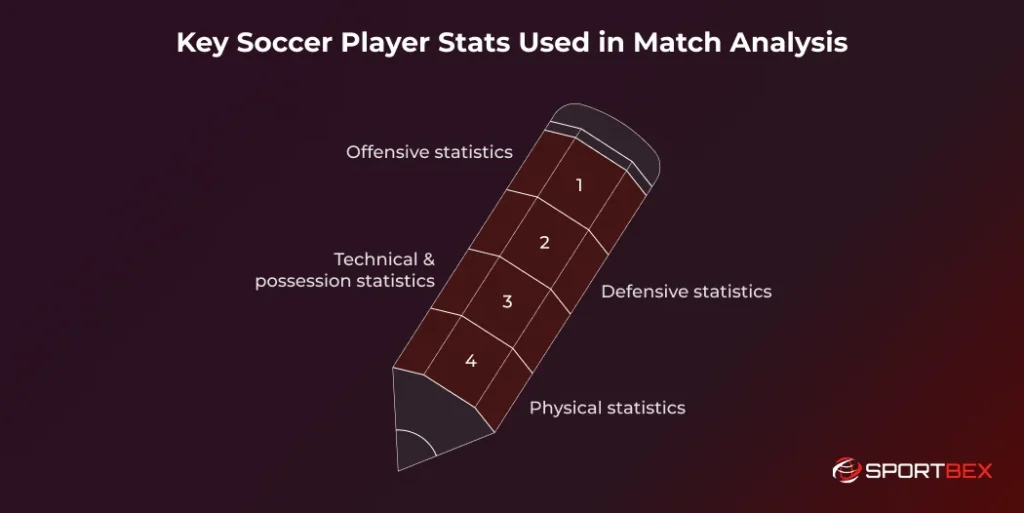
To make sense of soccer player stats, it’s helpful to break them down into clear categories. Each type of stat highlights a different part of a player’s role on the pitch. Here are some of the most important metrics used in soccer match analysis today:
Offensive Statistics
- Goals: The simplest and most direct attacking stat. Goals show how often a player finishes chances and makes a clear impact on the scoreboard. They remain the primary measure for forwards.
- Expected Goals (xG): xG estimates the quality of each scoring chance. It looks at factors like shot location, angle, and pressure. This helps explain whether a player is converting easy chances or taking impressive shots from tough positions.
- Assists: A measure of how often a player sets up goals for teammates. Assists highlight creators who contribute to build-up play and help unlock defenses.
- Key Passes: A key pass leads directly to a shot, even if it doesn’t become a goal. This stat is useful for spotting players who constantly create goal-scoring opportunities.
Defensive Statistics
- Tackles: Shows how many times a player wins the ball from an opponent. A high number indicates strong defensive work and good timing.
- Interceptions: Measures how often a player cuts out an opponent’s passes. This reflects game awareness, defensive positioning, and anticipation.
- Clearances and Blocks: Clearances show how often a defender removes the ball from dangerous areas. Blocks show how often they stop shots or passes. Together, they help judge defensive reliability.
Technical & Possession Statistics
- Pass Accuracy: The percentage of successful passes a player makes. High pass accuracy means a player keeps possession well, especially important for midfielders who control the tempo.
- Progressive Passes: Forward passes that move the ball into attacking areas. This is a key stat in soccer analytics, as it shows how effectively a player drives the team forward.
- Touches: The number of times a player touches the ball. High touch numbers usually mean the player is heavily involved in the match and plays an important role in build-up play.
Physical Statistics
- Distance Covered: Tracks how much ground a player runs during a match. Studies in leagues like the Bundesliga show that teams covering more high-intensity distance often perform better, especially in pressing systems.
- High-Intensity Runs: Measures how often a player makes fast, explosive movements. This is key for players in fast-paced roles such as wingers, full-backs, and pressing forwards.
- Work Rate: A mix of overall running, pressing, and defensive effort. High work rate often shows a player’s commitment and ability to contribute in both attack and defense.
How Soccer Player Stats Help Predict Match Outcomes
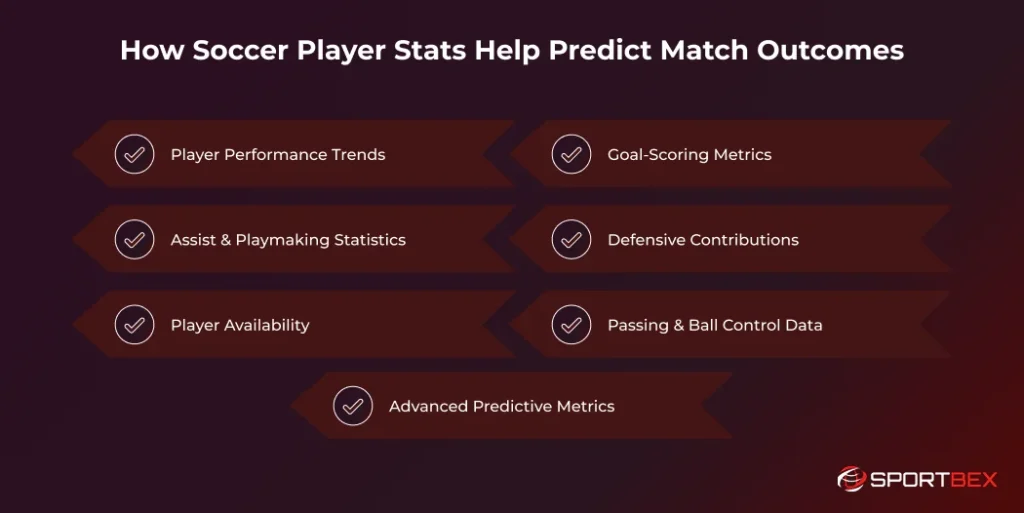
Understanding soccer becomes easier when we look at soccer player stats in the right way. These numbers show how a player is performing and what they might do in the next game. When analysts study these stats, they can make better predictions about match results by identifying patterns linked to winning soccer stats.
Player Performance Trends
When you look at how a player performs over several matches, you start to see clear patterns that help answer questions like why is this match significant? For example, if a forward has been scoring or creating chances for many games in a row, it usually means they’re in good form and likely to continue doing well.
The same is true for players whose performance suddenly drops. If their passing, defending, or shooting becomes weaker, it can be a sign that they may struggle in upcoming matches. These trends help predict how a player might perform next.
Get Your Soccer Data Here
Live scores, player stats, and team data from one simple API.
Goal-Scoring Metrics
Goals and expected goals (xG) are important because they show how often a player gets good chances and how well they finish them. If a player keeps scoring more than their xG, it usually means they’re confident and clinical in front of goal.
But if a player’s xG is high and they still don’t score much, it could mean they’re missing easy chances or going through a rough patch. These details help analysts guess whether a player is likely to score in future matches.
Assist & Playmaking Statistics
Key passes and assists tell us how much a player helps create goal-scoring opportunities. When a player regularly makes smart passes that lead to shots or goals, it shows they play an important role in the team’s attack.
Expected assists (xA) add even more detail. A soccer statistics API tracks xA to show how often a player creates high-quality chances, even if teammates don’t always finish them. This helps predict how much influence a player may have in the next game.
Defensive Contributions
Defensive stats show how well a player helps stop the opponents. Tackles, interceptions, and clearances are good signs that a defender is active and doing their job well. Players with strong defensive numbers usually help their team stay stable at the back.
But defense isn’t only about stopping attacks; it also helps start new ones. When defenders win the ball early or break up dangerous moves, they give their team more chances to control the game. This can have a big effect on predicting match results.
Player Availability
A player can have great stats, but they need to be on the field to make a difference. That’s why availability matters so much. Players who stay fit and play regularly are easier to rely on when predicting match outcomes.
However, if a player gets injured often or doesn’t play the full 90 minutes, their impact becomes uncertain. Analysts always check fitness levels and minutes played because teams depend heavily on their key players being available.
Passing & Ball Control Data
Passing stats show how well a player helps their team keep possession. A player with high pass accuracy makes the game smoother and reduces mistakes. This makes them important when predicting how a team will perform.
Progressive passes are also useful because they move the ball forward and create attacking opportunities. Players who make a lot of these passes usually help control the match and push the team into dangerous areas.
Advanced Predictive Metrics
Today’s analysts also use more advanced stats like expected assists (xA), player impact scores, and special ratings based on a player’s role. These metrics give a deeper look at how much a player contributes.
Some research also shows that using both expected goals and actual goals together leads to more accurate predictions. This combination helps analysts understand not just what happened, but what should have happened, leading to smarter forecasts.
Conclusion
Soccer player stats now play a major role in understanding how players and teams perform. They help reveal things we can’t always see during a match, like work rate, creativity, or defensive strength.
By looking at key metrics, from goals and xG to passes, tackles, and distance covered, coaches and analysts can make smarter decisions and even predict match outcomes more accurately.
Stats aren’t everything, but they add valuable clarity to the game. And as football becomes more data-driven, tools like live score platforms, leaderboards, and prediction apps will only become more useful. Understanding soccer player stats is one of the best ways to enjoy and analyze the sport in a deeper, smarter way.
All Your Soccer Data in One Place
Build your platform on reliable data with our 99.9% uptime guarantee
Frequently Asked Questions
Soccer player stats are numbers that show how a player performs during a match. They include goals, assists, passes, tackles, distance covered, and many other actions that help explain a player’s impact on the game.
They help coaches, analysts, and teams understand how players truly perform. Instead of guessing, they can use real data to study patterns, compare performances, and make better decisions during and after matches.
Offensive stats show how much a player contributes to creating or scoring goals. They include goals, assists, key passes, and expected goals (xG), which help measure attacking performance.
Important defensive stats include tackles, interceptions, blocks, and clearances. These numbers show how well a player protects the team and stops the opponent’s attacks.
Yes. By studying trends, goal-scoring behavior, passing patterns, and defensive performance, analysts can make educated predictions about how a match might turn out.
Recent Blog



How Accurate Are Live Odds on Horse Racing Online Bookmakers?
March 2, 2026
 8 min
8 min

Live Football Odds vs. Pre-Match Odds: Key Differences You Must Know
March 2, 2026
7 min
Track Matches, Goals, and Stats Instantly with Our Live Soccer API
API Free Trial