Walkover in Tennis Explained: Meaning, Rules, Impact on Betting

April 27, 2026

8 min read

Tennis is a sport built on endurance, precision, and unpredictability. Fans expect intense rallies and long matches that test both physical and mental strength. However, not every scheduled match reaches the court. Sometimes, a player advances without hitting a single shot, leaving fans and bettors confused.
This situation often raises questions among viewers who closely follow major events and those who rely on accurate match data. Understanding these outcomes is important not only for fans but also for platforms that depend on accurate updates.
Many systems rely on a real-time tennis data API to reflect such sudden changes instantly and maintain data accuracy.
In this guide, Walkover in Tennis Explained: Meaning, Rules and Impact on Betting, we will clearly explain what a walkover is, when it happens, the official rules behind it, and how it affects betting outcomes.
What Is a Walkover in Tennis?
A Walkover in Tennis occurs when a player advances to the next round because their opponent is unable to start the match. No points are played, and the match is officially recorded without any gameplay.
If you are wondering what a walkover in tennis is, it is essentially a pre-match withdrawal that results in automatic progression. The walkover in tennis meaning is simple. The match never begins, and the opponent moves forward without competition.
A walkover is very different from a normal win. It does not involve performance or scoring. For platforms tracking match data, using a tennis match update API ensures that such changes are recorded accurately and reflected in real time.
When Does a Walkover Happen in Tennis?
A Walkover in Tennis happens strictly before the match begins. This can occur hours or even minutes before the scheduled start time.
If a player experiences an injury during warm up or feels unfit to compete, they inform the tournament officials. Since no point has been played, the match is declared a walkover. This is a key part of understanding the walkover in tennis meaning and how it differs from in-match situations.
For digital platforms and analysts, timing is critical. Systems powered by a reliable tennis data API help ensure that these last-minute changes are updated without delay.
Official Tennis Walkover Rules (ATP/WTA)
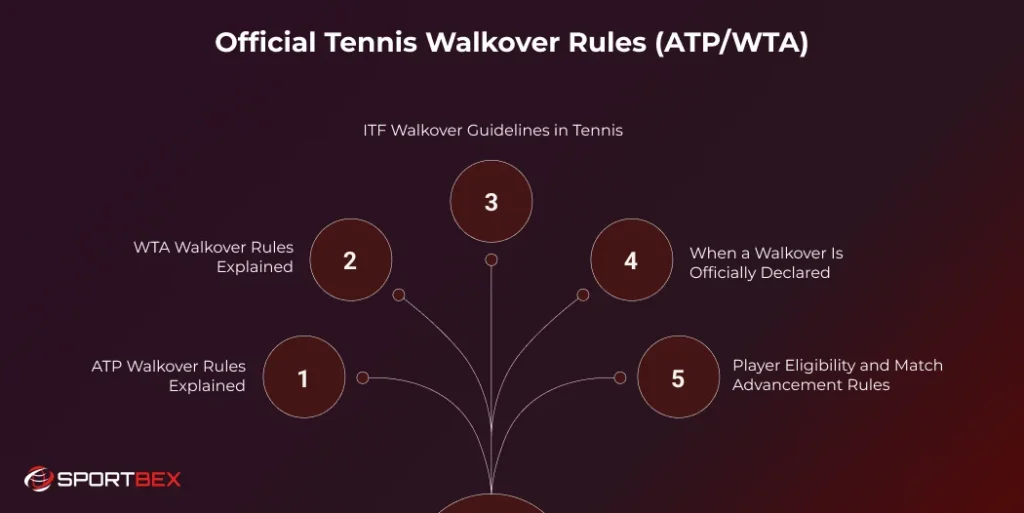
The official tennis walkover rules are defined by governing bodies such as ATP, WTA, and ITF. These rules ensure fairness and consistency across all tournaments.
ATP Walkover Rules Explained
The ATP defines a Walkover in Tennis as a situation where a player withdraws after the order of play is announced but before the match begins.
In this case, the opponent advances to the next round without playing any points. The player still receives ranking points for progression, but it is not counted as an official match win.
WTA Walkover Rules Explained
The WTA follows a similar structure under the same tennis walkover rules used in professional events.
If a player is unable to compete due to injury or verified medical reasons, the opponent is granted automatic progression. This ensures player safety while maintaining the structure of the tournament draw.
ITF Walkover Guidelines in Tennis
The ITF applies strict verification when declaring a Walkover in Tennis, especially in lower tier and Grand Slam events.
Medical staff often review the condition of the player before approving the withdrawal. This helps prevent misuse and ensures that all decisions are based on genuine circumstances.
When a Walkover Is Officially Declared
A walkover is officially declared once the referee accepts the player’s withdrawal before the first point is played.
At this moment, the match is removed from active play and recorded as a walkover in the draw. This clear timing is essential to define the walkover in tennis meaning accurately.
Player Eligibility and Match Advancement Rules
In a Walkover in Tennis, the player who is fit to compete is automatically eligible to move forward in the tournament draw. There is no requirement to play any points, but the advancement is officially recorded under tennis walkover rules.
The advancing player receives ranking points and prize money for the round reached, but it is not counted as a match win in official records.
Walkover vs Withdrawal vs Retirement
These three terms are often confused, but they have clear differences.
- Walkover: Player withdraws before the match starts after scheduling
- Withdrawal: Player exits before the tournament draw is created
- Retirement: Player stops after the match has started
Understanding what is a walkover in tennis compared to these situations helps fans and bettors interpret match outcomes correctly.
For accurate classification and reporting, platforms rely on structured data from a tennis statistics API for developers.
Common Reasons for Walkovers in Tennis
A Walkover in Tennis can happen for several reasons. These situations are part of the natural challenges of professional sports.
- Player Injury Before the Match: Injuries are the most common reason for a Walkover in Tennis. Players may withdraw to avoid further damage before the match begins.
- Illness and Medical Withdrawal: Sudden illness can make a player unfit to compete. In such cases, the opponent receives a walkover.
- Personal or Emergency Reasons: Unexpected personal situations can force a player to withdraw. These cases are rare but valid under tennis walkover rules.
- Scheduling Fatigue: Long and intense matches can lead to exhaustion. Players may withdraw if they are not physically ready for the next match.
- Disciplinary or Code of Conduct Issues: In rare cases, rule violations can lead to disqualification before a match. This results in a walkover for the opponent.
These scenarios highlight how unpredictable tennis can be. Analysts often use tennis analytics tools to track patterns related to player fitness and match outcomes.
Real Examples of Walkovers in Tennis
Famous Grand Slam Walkovers
- Wimbledon 2024, Men’s Quarterfinals: Novak Djokovic advanced to the semifinals without playing because Alex de Minaur withdrew with a hip injury.
- Wimbledon 2022, Men’s Semifinals: Nick Kyrgios reached his first Grand Slam final after Rafael Nadal withdrew due to an abdominal tear.
- ATP Finals 2014, Final: Novak Djokovic won the championship title after Roger Federer withdrew before the match due to a back injury.
- Roland Garros 2021, Round of 16: Matteo Berrettini advanced when Roger Federer withdrew to protect his knee before his Wimbledon campaign.
- Roland Garros 2018, Round of 16: Maria Sharapova advanced to the quarterfinals after Serena Williams withdrew due to a pectoral injury.
- Australian Open 1966, Women’s Final: Margaret Court (née Smith) received a walkover from Nancy Richey, one of the few final-round walkovers in Grand Slam history.
How a Walkover Affects Tennis Betting

If you enjoy wagering on sports, understanding what is a walkover in tennis is incredibly important. A match not happening drastically alters betting slips. Sportsbooks handle these situations differently, relying on accurate data from a tennis betting odds API to settle wagers.
What Happens to Pre-Match Bets in a Walkover
In a Walkover in Tennis, pre-match bets are usually canceled because the match never starts. Since no points are played, there is no official result for betting purposes. This ensures fairness for bettors who placed wagers before the withdrawal.
Live, Point-by-Point Tennis Data
Deliver every serve, break-point, and match-point as it happens on the court.
Are Bets Voided or Refunded?
Most sportsbooks void bets when a walkover occurs. The original stake is returned to the bettor without any profit or loss. This is a standard rule followed across major betting platforms.
Impact on Live (In-Play) Tennis Betting
Live betting is not affected directly because the match never begins. As a result, in-play betting markets do not open at all. Bettors do not get an opportunity to place live wagers in such cases.
Effect on Accumulator (Parlay) Bets
If a walkover match is part of an accumulator, that leg is usually removed. The rest of the bet continues with adjusted odds based on remaining selections. This ensures the bet remains valid without unfair advantage.
Differences in Bookmaker Rules for Walkovers
Some bookmakers may have slightly different rules for handling walkovers. While most follow standard void policies, a few may apply specific conditions. This is why it is always important to review platform rules before betting.
Does a Walkover Count as a Win in Tennis?
A Walkover in Tennis allows a player to advance, but it is not counted as an official match win.
The player receives ranking points and prize money for the round reached. However, it does not count in head to head records. The walkover in tennis clearly separates administrative advancement from competitive victory.
Conclusion
Understanding a Walkover in Tennis gives deeper insight into how tournaments function beyond the court. It explains why some matches never begin and how players still progress through the draw.
For fans, it removes confusion. For bettors, it clarifies how wagers are handled. For platforms and analysts, it highlights the importance of accurate data tracking and rule compliance.
A walkover may not involve gameplay, but it plays a crucial role in maintaining the structure and fairness of tennis tournaments. Knowing the rules, reasons, and betting impact ensures you stay informed whether you are watching matches or analyzing data.
Build Your Ultimate Tennis Platform
Get all the live scores and stats you need with our developer-friendly API.
Frequently Asked Questions
Policies vary by tournament. Sometimes organizers try to schedule an exhibition match or move another match to that court. Refunds are generally only offered if the walkover was the only scheduled match for that specific ticket session.
The player who gives the walkover earns points only for the rounds they previously won. The advancing player earns the ranking points for reaching the subsequent round.
Yes, though it is incredibly rare. If a player cannot start the final due to severe injury or illness, their opponent would win the championship via a walkover.
A walkover happens when a player withdraws before a match begins. A retirement occurs when a player withdraws during a match that has already started.
Most sportsbooks will void all bets placed on a match that results in a walkover, and the original stake is returned to the bettor. This is because the match was never officially started.
Recent Blog



How to build a low-latency live sports streaming app using APIs
September 9, 2026
 12 min

Cricket API Uptime & Availability: What Developers Should Know
August 27, 2026
13 min
Deliver Live Tennis Scores and Stats Ready for Your Users Fast!
API Free Trial