
The World Cup is one of the most popular sporting events for sportsbooks, betting exchanges and sports betting platforms. Millions of fans watch matches live, as thousands of bets are placed every second as the game unfolds.
The odds in a World Cup game don’t last long. A score change, a major match event, a player substitution, an injury, or an official review can instantly change the probability of an outcome. Sportsbooks have to react in seconds to maintain accurate betting markets and reduce trading risk.
This is where a Live Odds API becomes essential.
Sportsbooks don’t have to be manually updated. Instead they connect to a Live Odds API which pushes continuous updates to the market, keeping the betting markets in sync and displaying real time prices across web and mobile applications.
In this guide you will learn how live in-play odds API works behind the scenes, the technical challenges that come with handling World Cup scale traffic, and the features to look for when selecting an Sports API provider.
What Is In-Play (Live) Odds Data?
In-play odds, also known as live betting odds, are betting prices that change while a match is in progress.
While pre-match odds stay fairly consistent up to the start of the match, live odds are always changing according to events on the pitch.
Say for example, that there is a knockout game in the World Cup:
| Match Event | Possible Odds Reaction |
|---|---|
| Favorite team scores | Winning odds shorten |
| Underdog receives a red card | Handicap markets shift |
| Penalty awarded | Goal-related markets fluctuate |
| Match reaches extra time | New betting markets become available |
Every significant event affects the probability of different outcomes.
To keep betting markets accurate, sportsbooks depend on a Live Betting Odds API that delivers updated bookmaker odds almost instantly.
A modern Live Sports Odds API doesn’t simply send score updates. It also distributes:
- Dynamic odds
- Odds movement
- Market suspension status
- Match events
- Live score data
- Match statistics
- Betting market availability
These updates help sportsbooks display accurate prices while protecting themselves from outdated odds.
Why Live Odds Matter More During the World Cup
Each match garners a large amount of international interest and betting activity spikes before the start and during the match.
This means sportsbooks will have to contend with:
- Thousands of odds changes a minute
- Several cricket bookmakers are updating their prices at the same time
- High API traffic from betting apps
- High concurrency of users
- Market alignment in progress
Even a few seconds delay can result in stale odds, wrong payouts, or betting opportunities that put operators at unnecessary financial risk.
That’s why low latency is one of the key performance metrics for any Sports Betting Data API.
How a Live In-Play Odds API Works Technically
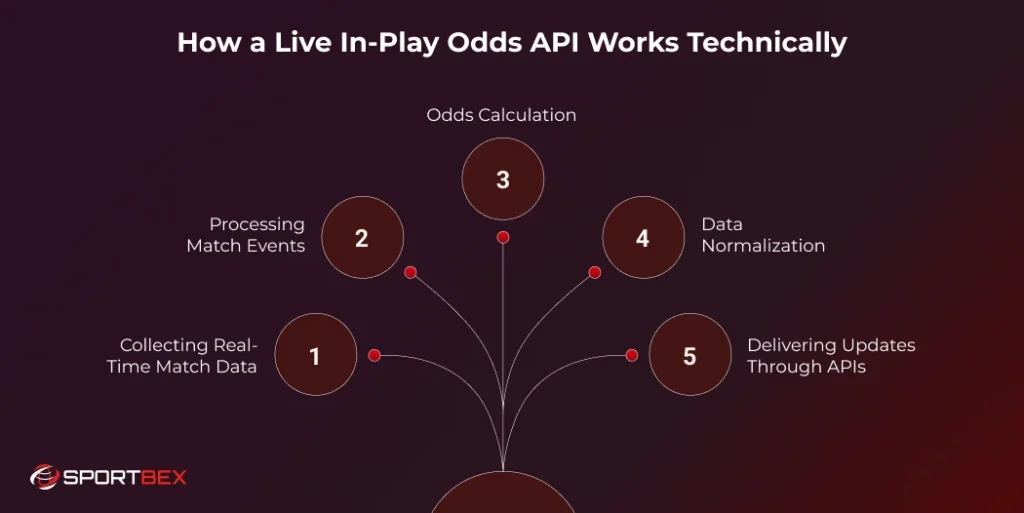
Although live betting appears simple to users, several backend systems work together to deliver every odds update.
A typical architecture looks like this:
Official Sports Data
        │
        ▼
Data Collection
        │
        ▼
Odds Trading Engine
        │
        ▼
Odds Calculation
        │
        ▼
Data Normalization
        │
        ▼
API Infrastructure
   ├── REST Endpoints
   └── WebSocket Streaming
        │
        ▼
Sportsbook Applications
Let’s look at each stage.
1. Collecting Real-Time Match Data
Everything starts with collecting accurate real-time match data from official sports data feeds, trusted data partners, or stadium-based data scouts. Every event that occurs during the match is captured and sent to the odds provider’s infrastructure within seconds.
Typical live events include:
- Goals
- Yellow and red cards
- Penalties
- Player substitutions
- Corner kicks
- Match clock updates
- Injury time
- VAR decisions
- Match statistics such as possession, shots, and fouls
This continuous stream of real-time sports data forms the foundation of every In-Play Odds API. Once an event is received, it is immediately forwarded for validation and odds calculation.
The speed and accuracy of this incoming data directly affect how quickly sportsbooks can update betting markets. Even a delay of a few seconds can result in outdated odds, poor user experience, and increased trading risk during high-profile tournaments like the FIFA World Cup.
2. Processing Match Events
Once live match data is received, it passes through an event-processing engine that verifies each event before updating betting markets. This validation ensures only confirmed match events affect the odds, reducing the risk of incorrect market movements.
For example, when a goal is scored, the system validates the event, temporarily suspends the affected markets, and sends the data to the trading engine. After new probabilities are calculated, the markets reopen with updated odds.
This entire process takes only a few seconds and is repeated for every key event, match update, and player performance. During World Cup matches, fast event processing helps sportsbooks keep live betting odds accurate, synchronized, and up to date with minimal latency.
3. Odds Calculation
After a match event is verified, the trading engine recalculates the odds for all affected betting markets. Instead of relying only on the latest score, the system analyzes multiple factors to generate updated probabilities.
These factors typically include the current score, time remaining in the match, team strength, historical performance, player availability, and recent betting activity. Together, they help produce odds that accurately reflect the changing state of the game.
These probabilities are then converted into different betting formats, such as decimal odds in sports betting, which are widely used by sportsbooks and bettors worldwide.
Professional trading engines also monitor odds movement across multiple bookmakers to keep prices competitive while supporting effective risk management. Once the calculations are complete, the updated odds are instantly distributed to sportsbooks through the API.
4. Data Normalization
Different bookmakers often use different naming conventions.
For example:
| Bookmaker A | Bookmaker B |
| Team A | Home Team |
| Match Winner | 1X2 |
| Total Goals | Over/Under Goals |
Before data reaches customers, providers normalize this information into a consistent format.
This simplifies API integration because developers don’t need to build custom logic for every bookmaker.
5. Delivering Updates Through APIs
Once the latest odds are available, they are delivered using two common methods.
REST Endpoints
REST APIs work well for retrieving snapshots of data.
They’re commonly used for:
- Upcoming fixtures
- Competition schedules
- Historical odds
- Team information
- Market catalogs
REST is simple to implement but requires repeated requests to check for updates.
WebSocket Streaming
For live betting, polling an API every few seconds is inefficient.
WebSockets create a persistent connection between the server and client.
Instead of repeatedly asking for updates, the server pushes new odds immediately whenever markets change.
Benefits include:
- Lower latency
- Reduced bandwidth usage
- Faster market updates
- Better user experience
- Fewer unnecessary API requests
For live betting platforms, WebSocket API streaming is typically the preferred approach for delivering Live World Cup Odds.
Key Challenges During World Cup-Scale Events
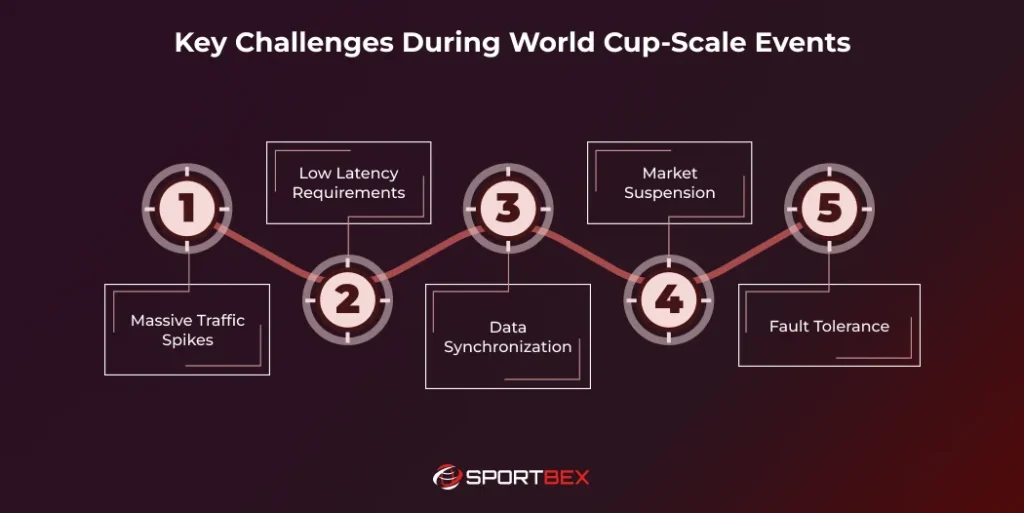
Running a Live Betting API during the World Cup is very different from supporting a standard league match.
Traffic can increase dramatically within minutes, putting pressure on every layer of the infrastructure.
Here are some of the biggest technical challenges.
Massive Traffic Spikes
A popular knockout match can trigger millions of API requests from sportsbooks, betting apps, and analytics platforms at the same time.
Without horizontal scaling, servers may struggle to keep up with demand.
Cloud-based infrastructure with auto-scaling helps distribute traffic across multiple servers to maintain consistent performance.
Get a Ready-Made Platform On Rent.
Get Started Today
Low Latency Requirements
Every second matters in live betting.
If odds arrive late, users may see outdated prices or place bets that no longer reflect the current state of the match.
Leading providers optimize their infrastructure to minimize delays across data collection, processing, and delivery.
Data Synchronization
Pre- Match Odds, live odds, live scores, and match statistics must stay synchronized.
Imagine showing:
- 2–1 score
- Old odds from before the goal
This creates confusion for users and increases operational risk.
Reliable data synchronization ensures every update reflects the latest match state across all connected systems.
Market Suspension
Some events require betting markets to pause immediately.
Examples include:
- Penalty decisions
- VAR reviews
- Red cards
- Goals under review
Automatic suspension prevents bets from being accepted while odds are being recalculated.
Once pricing is updated, markets reopen with the latest odds.
Fault Tolerance
Infrastructure failures during a World Cup match can have significant business consequences.
To reduce downtime, API providers typically use:
- Multiple data centers
- Redundant servers
- Load balancing
- Automatic failover
- Continuous monitoring
This helps maintain service availability even when individual components fail.
What Markets Are Covered in Live World Cup Odds?
A comprehensive Live Odds API should support more than just match winner markets.
Sportsbooks often offer hundreds of betting options throughout a World Cup match.
Some of the most common markets include:
| Market | Live Updates |
|---|---|
| Match Winner | ✔ |
| Double Chance | ✔ |
| Draw No Bet | ✔ |
| Asian Handicap | ✔ |
| Total Goals | ✔ |
| Both Teams to Score | ✔ |
| Next Goal | ✔ |
| Correct Score | ✔ |
| Half-Time Result | ✔ |
| Player Props (where available) | ✔ |
The availability of specific markets depends on the competition, sports data provider, and bookmaker integrations.
Supporting a wide range of betting markets allows operators to offer a richer betting experience and keep users engaged throughout the match.
How Sportbex’s Odds API Handles World Cup-Scale Traffic
Supporting high-profile tournaments requires more than simply delivering odds. The infrastructure also needs to maintain speed, consistency, and uptime when traffic increases significantly.
Sportbex’s Sports Odds API is designed to help sportsbooks, betting operators, and sports technology companies manage live betting workloads with features such as:
- Real-time odds updates across multiple sports
- WebSocket streaming for lower-latency data delivery
- REST APIs for fixtures, historical data, and market information
- Coverage of multiple betting markets and bookmaker odds
- Consistent data formats that simplify API integration
- Scalable infrastructure designed for high-demand sporting events
If you’re evaluating providers, it can also help to understand what dynamic odds are in sports betting and how they differ from fixed pre-match pricing.
Conclusion
Live betting depends on speed, accuracy, and reliability.
An In-Play Odds API enables sportsbooks to react instantly to match events, synchronize betting markets, and deliver real-time experiences during high-profile tournaments like the FIFA World Cup.
Behind every live odds update is a sophisticated system that collects match events, recalculates probabilities, normalizes bookmaker data, and distributes updates through WebSockets and REST APIs.
For operators building or scaling a betting platform, choosing an API with low latency, broad market coverage, resilient infrastructure, and straightforward integration is just as important as the odds themselves.
Investing in the right live betting technology helps create a better user experience while supporting more efficient trading operations during the busiest sporting events of the year.
Frequently Asked Questions
An In-Play Odds API provides real-time betting odds that update automatically as a sporting event progresses. It delivers live market changes based on match events such as goals, penalties, red cards, and substitutions.
A pre-match API focuses on odds before an event starts. A Live Odds API continuously updates betting markets during the match, making low latency and real-time delivery essential.
WebSockets maintain a persistent connection between the server and client, allowing odds updates to be pushed instantly instead of relying on repeated API requests. This reduces latency and improves the live betting experience.
Odds change in response to match events, betting activity, updated probability calculations, and bookmaker risk management. Goals, injuries, VAR decisions, and red cards are common triggers.
Key considerations include update speed, WebSocket support, market coverage, API documentation, scalability, uptime, data consistency, and ease of integration.
Yes. Many providers offer live odds across football, basketball, tennis, cricket, horse racing, and other sports through a single API platform.
They combine real-time sports data, automated trading engines, and event-driven architecture to update scores, statistics, and betting markets simultaneously. This helps ensure users always see the latest available odds.
Recent Blog



How to build a low-latency live sports streaming app using APIs
September 9, 2026
 12 min

Cricket API Uptime & Availability: What Developers Should Know
August 27, 2026
13 min
Access Real-Time Sports Odds and Boost Your Betting Platform
API Free Trial