Cricket API Uptime & Availability: What Developers Should Know

August 27, 2026

13 min read

A cricket app can have a great design, but users will quickly notice when live scores stop updating or match data becomes outdated.
This makes cricket API uptime an important consideration for developers. A reliable API keeps scores, fixtures, player stats, match events, and other cricket data available when users need them.
But uptime is only one part of API reliability. Developers also need to look at cricket API availability, response time, data freshness, and error rates.
This becomes even more important for live score apps, fantasy sports platforms, sportsbooks, and sports websites where a short data interruption can affect the user experience.
In this guide, we’ll look at how cricket API uptime is measured, how it differs from cricket data availability, how to monitor API health, and what developers should check before choosing a cricket data API for their application.
What Is Cricket API Uptime?
Cricket API uptime is the percentage of time an API remains operational and able to respond to valid requests during a defined period.
For example, if a cricket API has 99.9% monthly uptime, it means the service was available for approximately 99.9% of the measurement period.
The remaining time represents potential downtime, depending on how the provider defines and measures it.
A simple way to understand it is:
Uptime measures whether the API service is operational.
This is particularly important for cricket applications because demand is not evenly distributed throughout the day.
A cricket app may receive normal traffic between matches but experience a significant increase during an IPL final, World Cup match, or closely contested T20 game.
A short outage during that period can have a much larger business impact than the same outage during a quiet period.
What Does 99.9% Uptime Actually Mean?
Uptime percentages can sound very similar while representing different amounts of downtime.
| Uptime target | Approximate maximum downtime per 30-day month |
|---|---|
| 99% | 7 hours 12 minutes |
| 99.5% | 3 hours 36 minutes |
| 99.9% | 43 minutes 12 seconds |
| 99.95% | 21 minutes 36 seconds |
| 99.99% | 4 minutes 19 seconds |
These are mathematical approximations, not guarantees for a specific provider.
The important point is that 99.9% uptime still allows roughly 43 minutes of downtime in a 30-day month.
For a live sports product, those 43 minutes could occur during several critical matches rather than during low-traffic periods.
How Is API Uptime Calculated?
A common uptime calculation is:
API Uptime % = [(Total Time − Downtime) ÷ Total Time] × 100
For example, suppose an API is measured over a 30-day month containing 43,200 minutes.
If the API is unavailable for 20 minutes:
Uptime = [(43,200 − 20) ÷ 43,200] × 100
That produces approximately 99.954% uptime.
However, developers should not assume every provider uses exactly the same calculation.
An SLA may define:
- Which HTTP responses count as failures
- Whether planned maintenance is excluded
- How partial outages are measured
- Whether network failures are included
- Which endpoints are covered
- Whether rate-limit responses count as downtime
- How monitoring locations are selected
For example, Google Cloud defines Monthly Uptime Percentage using total minutes minus qualifying downtime, while its SLA documentation also specifies which requests are considered valid.
That distinction matters when comparing providers.
Uptime Is Not the Same as Successful Data Delivery
An API can return HTTP 200 while providing stale information.
Consider this example:
API request → HTTP 200
Score → 142/4
Last update → 18 minutes ago
Match status → LIVE
Technically, the API endpoint is responding.
From the user’s perspective, however, the cricket data is not functioning correctly.
This is why a serious monitoring strategy should measure service availability and data freshness separately.
Why Does Cricket API Uptime Matter?
A reliable cricket API is infrastructure for the features your users actually see.
If the API becomes unavailable, the impact can spread across several parts of an application.
Live Scores Can Stop Updating
A live score application depends on continuous data delivery.
If requests fail during a match, users may see an old score, an empty scorecard, or an error message.
That creates an immediate trust problem.
Betting Platforms Can Be Exposed to Operational Risk
Sportsbooks and betting platforms require timely cricket data to track match states and support live betting workflows.
Score changes, wickets, innings transitions, and other events can affect the markets displayed to users.
For platforms using both scores and odds, it is important to understand how these feeds differ. This cricket odds API vs cricket scores API comparison explains the different roles they can play in a betting platform.
A reliable cricket data API helps operators keep these updates consistent. Developers should also consider API response time and data freshness alongside uptime when assessing reliability.
Fantasy Platforms Depend on Timely Events
Fantasy products use match events to calculate player performance and fantasy points.
A delayed wicket, boundary, dismissal, or player status update can affect the user experience and potentially downstream scoring workflows.
Sports Websites Can Lose Engagement
A sports publisher that fails to refresh live match information may lose users to another site that provides more current information.
The technical problem therefore becomes a product and retention problem.
What Is Cricket API Availability?
Cricket API availability refers to whether the API and its relevant functionality are accessible and usable when required.
It is closely related to uptime, but availability can be evaluated at a more functional level.
For example, an API may have:
- High server uptime
- Working authentication
- Fast responses
- But missing live cricket data
In that situation, the API infrastructure may technically be online while the required cricket service is not fully available.
This distinction is important for production applications.
Uptime vs. Availability
| Metric | What it tells you | Example |
|---|---|---|
| Uptime | Whether the service is operational | API responds to requests |
| Availability | Whether the required service can be used | Live score endpoint is accessible |
| Response time | How quickly the API responds | Request returns in 180 ms |
| Data freshness | How current the information is | Score updated 2 seconds ago |
| Accuracy | Whether the information is correct | Score matches the verified source |
A mature monitoring setup should track all five.
Cricket API Uptime vs. API Availability: What’s the Difference?
The terms are often used interchangeably, but developers should treat them as related rather than identical concepts.
Imagine a provider has four major services:
Cricket API
│
├── Fixtures API       → Available
├── Teams API          → Available
├── Historical API     → Available
└── Live Scores API    → Unavailable
The overall infrastructure may still be running.
But if your application depends on live scores, the service is effectively unavailable for your use case.
This is why providers should ideally publish service-level status information rather than only advertising one company-wide uptime percentage.
For example, Sportbex publicly reports uptime separately for its Cricket API and other services on its status page, illustrating why service-specific monitoring can be more useful than a single platform-wide number.
Why Cricket Data Availability Matters for Developers
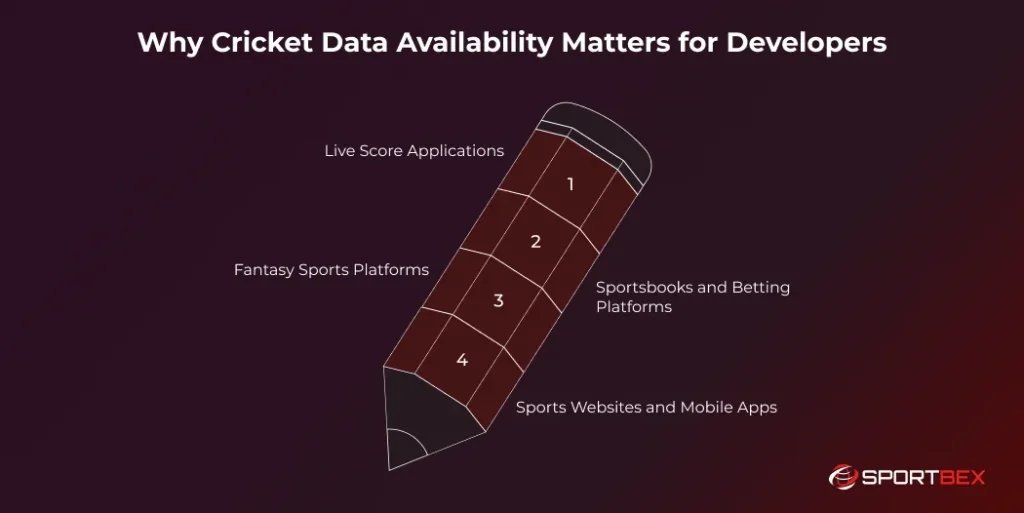
Cricket data availability affects how reliably an application delivers live match information. Developers should evaluate more than cricket API uptime and choose a reliable cricket data API that consistently provides accurate scores, match events, player statistics, fixtures, and other essential data.
The impact can vary depending on the type of application.
Live Score Applications
Live score apps depend on frequent data updates throughout a match. Users expect scores, wickets, overs, and match status to change as the game progresses.
If the API becomes unavailable or the data becomes stale, users may see an old score or incorrect match status. For live products, even a short delay can reduce trust in the application.
Sportsbooks and Betting Platforms
Sportsbooks rely on timely cricket data to track match states and support live betting workflows.
Score changes, wickets, innings transitions, and other events can affect the markets displayed to users.
For more complex betting products, developers may also need to understand how fancy betting in cricket works and what data is required to support those markets.
A reliable cricket data API helps operators keep these updates consistent. Developers should also consider API response time and data freshness alongside uptime when assessing reliability.
Fantasy Sports Platforms
Fantasy platforms use cricket events to update player statistics and calculate fantasy points. A delayed or missing event can affect scores, rankings, and other parts of the user experience.
For this reason, fantasy applications need consistent cricket data availability, especially during live matches. Developers should monitor both API connectivity and the freshness of incoming match data.
Sports Websites and Mobile Apps
Sports websites and mobile apps often depend on several cricket data points at the same time, including fixtures, teams, players, live scores, commentary, and statistics.
If one important endpoint fails, parts of the match experience may stop working. A well-designed integration should use caching, retries, and fallback states to keep the application useful during temporary API issues.
How to Monitor Cricket API Uptime
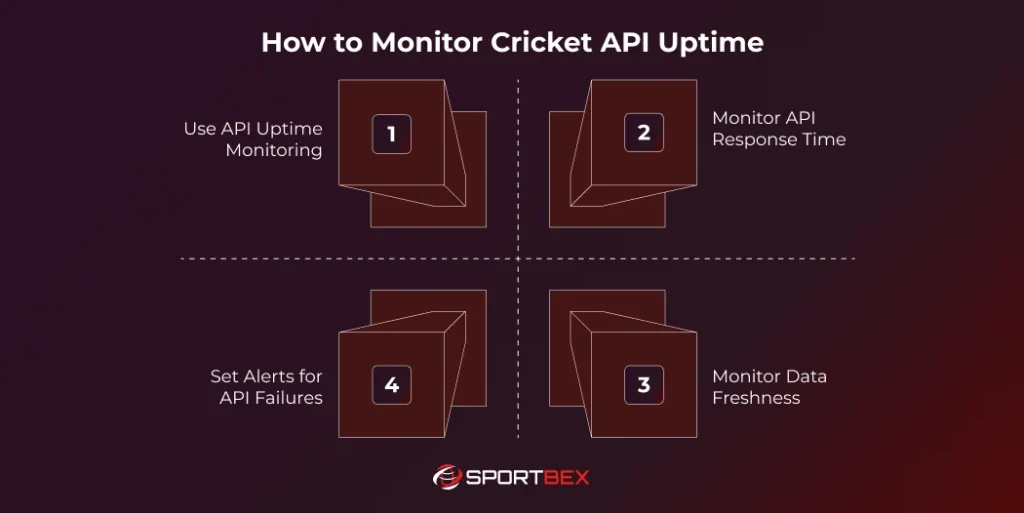
Monitoring cricket API uptime helps developers detect service interruptions before they affect users. A reliable setup should track availability, response time, data freshness, and repeated failures to confirm that the cricket data API is working properly.
Use API Uptime Monitoring
Set up regular health checks for the API endpoints your application depends on most.
For example, you can periodically check a live matches endpoint and verify the HTTP status, response structure, and required fields. This helps detect outages even when users have not reported a problem.
Do not rely only on a provider’s status page. Monitoring from your own application environment can show whether the API is accessible from your infrastructure.
Monitor API Response Time
An API can be available but still respond too slowly for a live cricket application.
Track response time over time and pay attention to spikes, timeouts, and slow requests during major matches. Looking at metrics such as p95 latency can also reveal performance problems that an average response time may hide.
This is particularly useful when comparing cricket API availability across different providers or infrastructure setups.
Monitor Data Freshness
For live cricket applications, a successful API response does not always mean the data is current.
Check the timestamp of the latest score or match event and compare it with the current time. If the API keeps returning the same score for several minutes while a match is in progress, your monitoring system should flag the data as stale.
This helps distinguish an API outage from a cricket data availability problem.
Set Alerts for API Failures
Configure alerts when your monitoring system detects repeated failed requests, high latency, stale data, or unexpected API responses.
Avoid triggering an alert for every single failed request. A temporary network issue can resolve itself, so consecutive failures or sustained problems are usually better alert conditions..
A simple flow can be:
API Health Check
       ↓
Request Fails
       ↓
Retry with Backoff
       ↓
Failure Continues
       ↓
Alert Development Team
The goal of API uptime monitoring is not just to report downtime. It should help your team identify problems quickly and understand whether the issue is with connectivity, API performance, or the freshness of the cricket data.
What Developers Should Look for in a Reliable Cricket Data API
Choosing a cricket data API involves more than comparing endpoints or advertised cricket API uptime. Evaluate its reliability, data quality, coverage, performance, documentation, and support to ensure it meets your application’s technical and business needs.
1. Consistent API Availability
Check whether the provider can keep important endpoints available during live matches and periods of high traffic.
Look for a clear uptime target and, where required, a defined cricket API SLA. Also check how the provider calculates downtime and which endpoints are included in the commitment.
2. Fresh and Timely Cricket Data
High uptime does not help if the data itself is outdated. Live scores, wickets, overs, match status, and ball-by-ball events need to reach your application without unnecessary delays.
Ask the provider how frequently live data is updated and how cricket data availability is maintained during ongoing matches.
3. Wide Cricket Coverage
Make sure the API covers the competitions and formats your application needs.
Depending on the product, this may include:
- IPL and other major leagues
- International matches
- T20, ODI, and Test cricket
- Domestic competitions
- Teams and players
- Fixtures and results
- Historical statistics
- Ball-by-ball data
If IPL coverage is a major requirement, reviewing different IPL cricket data feed APIs can help you compare coverage, data types, and integration requirements before making a decision.
Coverage should be checked before integration rather than after development has started.
4. Stable Performance During Peak Traffic
Major cricket matches can generate sudden increases in API requests. A provider should be able to handle these periods without major increases in latency or failed requests.
If possible, test response times during live matches and review metrics such as timeout rates and p95 latency.
5. Clear Rate Limits and Error Handling
Understand how many requests your plan supports and what happens when the limit is reached.
The API should also provide clear HTTP status codes and error responses so developers can implement retries, logging, and fallback behavior correctly.
6. Reliable Documentation and Support
Good documentation reduces integration time and makes troubleshooting easier.
Check whether the provider clearly documents authentication, endpoints, parameters, response formats, error codes, rate limits, version changes, and support channels.
A public status page and incident history can also help you assess how the provider handles service interruptions.
7. Monitoring and Reliability Tools
A good provider should make it easier to monitor the service from your own infrastructure.
Look for useful information around uptime, incidents, API status, and data updates. Your team should still use its own API uptime monitoring rather than relying entirely on provider-side monitoring.
The best approach is to combine provider status information with your own checks for availability, latency, and data freshness.
Cricket API Uptime Checklist for Developers
Before integrating a cricket data API into a production application, developers should check more than its advertised uptime percentage.
Use this cricket API uptime checklist to evaluate reliability, performance, data quality, and operational support.
Reliability and Availability
- Check the provider’s published cricket API uptime target.
- Confirm how uptime and downtime are calculated.
- Check whether important live cricket endpoints are covered.
- Review the provider’s status page and incident history.
- Check whether planned maintenance is excluded from downtime.
Cricket API SLA
- Confirm whether a formal cricket API SLA is available.
- Check the guaranteed availability percentage.
- Understand downtime exclusions and measurement rules.
- Check support and incident response commitments.
- Review any service-credit terms.
Data Quality and Freshness
- Test live score update frequency.
- Check ball-by-ball data availability.
- Verify match status and event updates.
- Monitor timestamps for stale data.
- Confirm the competitions and formats you need.
API Performance
- Test average API response time.
- Monitor p95 and p99 latency.
- Check timeout and error rates.
- Understand API rate limits.
- Test performance during major cricket matches.
Monitoring and Recovery
- Set up API uptime monitoring from your own infrastructure.
- Configure alerts for repeated API failures.
- Monitor data freshness separately from API availability.
- Implement retries with exponential backoff.
- Define a caching and fallback strategy.
Final Evaluation
A reliable cricket data API should perform consistently across availability, data freshness, response time, and coverage.
Do not choose a provider based on uptime alone. Test the API against your application’s actual requirements before moving it into production.
Conclusion
Cricket API uptime is an important part of building a reliable cricket application, but it should not be the only metric developers consider.
A dependable cricket data API should provide consistent availability, timely updates, accurate data, predictable response times, and the coverage your application requires.
It is also important to monitor the API from your own infrastructure. Tracking cricket API availability, response time, data freshness, and failures can help your team identify problems before they affect users.
Before choosing a provider, review its cricket API SLA, test performance during live matches, and check how the service handles outages and data delays.
The goal is simple: keep the right cricket data available when your users need it, especially when a live match odds is in progress.
Frequently Asked Questions
Cricket API uptime is the percentage of time a cricket API remains operational and able to respond to valid requests. It indicates whether the API service is accessible, but it does not necessarily confirm that the cricket data being returned is fresh or complete.
Cricket API availability refers to whether the API and its required functions are accessible when an application needs them. For live cricket products, availability should be considered alongside response time, data freshness, and error rates.
Cricket data availability ensures that applications can consistently receive scores, match events, fixtures, player statistics, and other required information. Poor availability can lead to stale scores, broken features, and a poor user experience.
There is no single uptime target that suits every application. A 99.9% uptime target allows approximately 43 minutes of downtime in a 30-day month, so developers should consider the application's criticality, expected traffic, and the provider's cricket API SLA.
Use API uptime monitoring to regularly test important endpoints from your own infrastructure. Monitor HTTP errors, response time, timeouts, data freshness, and repeated failures instead of checking only whether the API returns a 200 status code.
Yes. An API can return a successful HTTP response while providing stale or incomplete cricket data. This is why developers should monitor cricket data availability separately from infrastructure uptime.
No. Uptime only indicates whether the service is operational. A reliable cricket data API should also deliver current and accurate data with predictable response times and consistent coverage.
Recent Blog



How to build a low-latency live sports streaming app using APIs
September 9, 2026
 12 min

How to Scale Your Sportsbook with a Reliable Tennis Odds API
August 11, 2026
9 min
Start your free API key and get live cricket scores instantly
API Free Trial