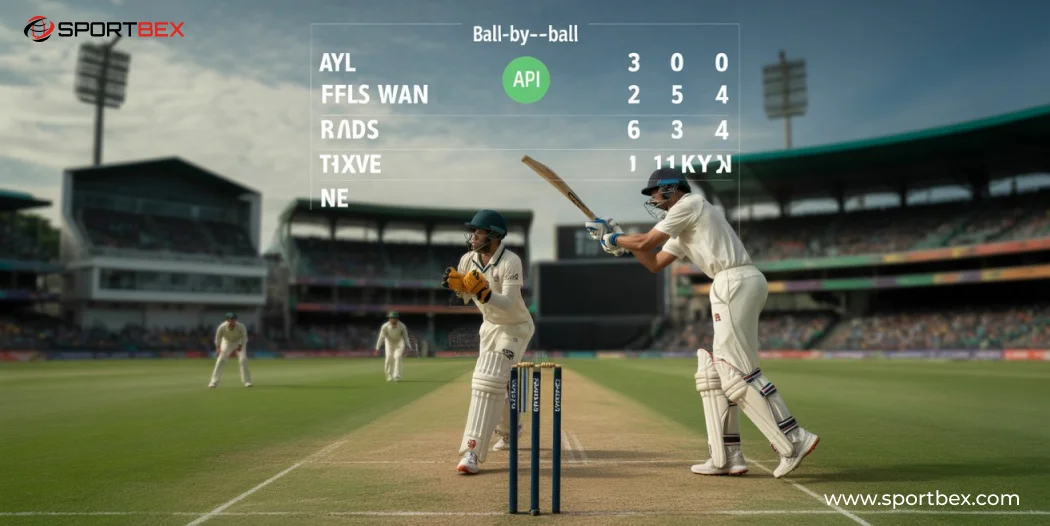
In cricket, every ball changes the game but in digital platforms, every millisecond decides revenue.
For sportsbooks, fantasy platforms, and betting software providers, real-time data is no longer optional. Users don’t just watch matches anymore they react to them instantly. A delayed update means missed bets, incorrect odds and ultimately, lost trust.
This is where the Cricket Ball by Ball Live API becomes critical. It delivers every match event in real time, allowing platforms to respond instantly to each delivery. Instead of static score updates, you get a continuous stream of structured data that powers interaction, engagement, and monetization.
For B2B providers and platform owners, this API is not just a feature. it’s the core engine behind real-time cricket ecosystems.
What is a Cricket Ball by Ball Live API?
A Cricket Ball by Ball Live API is a real-time data service that streams granular match events for every ball bowled, structured in a machine-readable format such as JSON.
Unlike traditional cricket APIs that update scores at intervals, this API captures and delivers each ball as an independent event, including contextual match data.
A typical ball event includes:
- Over and ball number
- Batsman and bowler information
- Outcome (runs, wicket, extras)
- Updated team score and match state
However, the true value of this API lies in how it integrates with platform logic.
When a ball is delivered, the API enables systems to instantly:
- Update live score interfaces
- Trigger betting market changes
- Recalculate probabilities and odds
- Synchronize with live streaming overlays
This makes Cricket Ball by Ball Live data the foundation for building interactive, real-time cricket applications.
Why Ball-by-Ball Data is Critical for Cricket
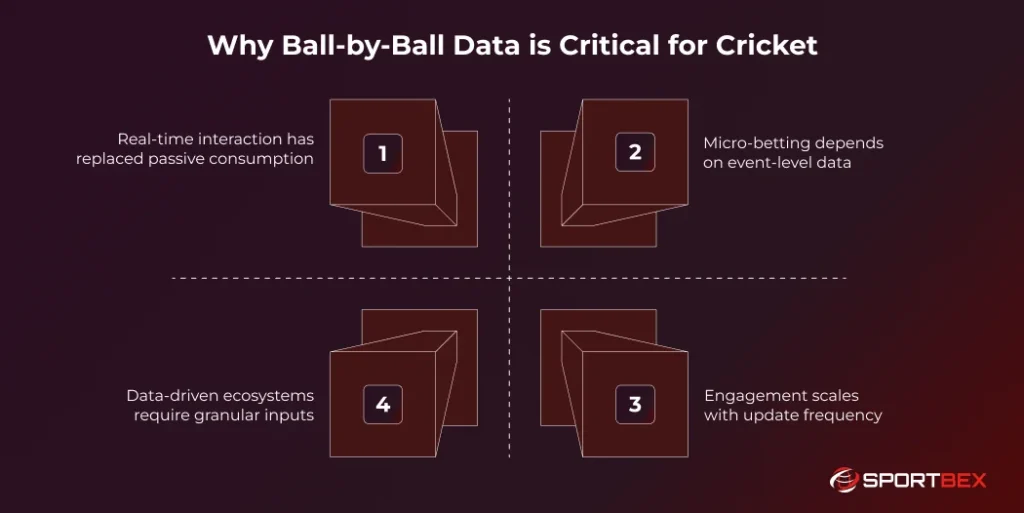
The increasing demand for cricket live ball by ball data is driven by how users interact with sports. The shift is not just technological, it is behavioral.
Real-time interaction has replaced passive consumption
Users no longer wait for over summaries or score refreshes. They engage continuously, reacting to each ball. This behavioral shift requires platforms to deliver high-frequency updates with minimal latency.
Micro-betting depends on event-level data
One of the fastest-growing segments in sports betting is micro-betting. These markets allow users to place bets on highly specific outcomes such as:
- Result of the next ball
- Runs in the current over
- Dismissal type
Such use cases are only possible with ball by ball live cricket data streams, similar to how real-time cricket bookmakers rely on instant event-level updates to calculate accurate odds.
Engagement scales with update frequency
Platforms delivering live cricket score ball by ball updates consistently outperform traditional systems in key engagement metrics. Each ball becomes a trigger for user action, leading to:
- Increased session duration
- Higher interaction rates
- Stronger retention loops
Data-driven ecosystems require granular inputs
Ball-level data feeds multiple systems simultaneously, including:
- AI-based prediction models
- Fantasy scoring engines
- Real-time analytics dashboards
For investors and analysts, this level of granularity enables more accurate performance modeling and market insights.
Get Live Cricket Data Now
Integrate Sportbex Cricket API for real‑time scores, stats & odds.
How Cricket Ball by Ball API Works
A Cricket Ball by Ball API operates through a layered architecture designed to ensure accuracy, consistency, and low latency.
At the foundation is the data collection layer, where match events are captured from official scoring systems and verified sources. This ensures that every ball is recorded reliably. In high-level matches, advanced tracking technologies further enhance data precision.
The data then moves into a processing layer, where it is validated, normalized, and structured. Events are categorized, inconsistencies are resolved, and the data is prepared for delivery. This stage ensures that downstream systems receive clean and standardized information.
The final layer is real-time delivery. Modern APIs use technologies such as WebSockets to push updates instantly, eliminating the need for repeated requests. This allows platforms to receive updates the moment a ball is bowled.
Leading platforms go a step further by implementing event-driven architecture. In this model, each ball acts as a trigger for system actions, enabling instant updates across user interfaces, betting engines, and notification systems.
Key Features of a Cricket Ball by Ball Live API
A high-performance API must deliver more than just data. it must provide speed, depth, and seamless integration.
The most critical factor is latency. Real-time platforms require updates to be delivered within milliseconds to maintain accuracy and responsiveness. Even minor delays can disrupt betting systems and reduce user trust.
Coverage is another essential component. A robust API should support major tournaments, leagues, and formats to ensure consistent engagement throughout the cricket calendar.
In addition to coverage, advanced APIs provide context-rich insights such as run rates, match pressure indicators, and probability models. These insights enhance both user experience and operational decision-making.
To summarize, a strong API should offer:
- Sub-second real-time data delivery
- Coverage across ICC and T20 Matches and major Cricket Leagues
- Contextual insights beyond basic scores
- Seamless integration with live cricket score api, Cricket Data API and Cricket Live Streaming
- Access to historical ball-by-ball datasets for analytics
How to Choose the Right API Provider (Why Sportbex Stands Out)
Choosing the right API provider directly impacts your platform’s performance, especially in real-time environments like live cricket betting.
Latency should be your top priority. Even a small delay can affect odds accuracy and user experience. Sportbex is built with low-latency infrastructure, ensuring ball-by-ball updates are delivered instantly and enabling true real-time interaction.
Data reliability is equally critical. Inconsistent data can break trust and disrupt betting systems. With a provider like Sportbex, data flows through validated pipelines, maintaining accuracy across every match event.
Coverage and scalability also play a key role. The API should support major tournaments, including ICC events and top Cricket Leagues, while handling high traffic during peak matches without performance issues.
From an integration perspective, developer-friendly APIs and clean documentation reduce implementation time and operational complexity something modern platforms cannot afford to overlook.
Ultimately, faster and more reliable data leads to higher engagement and better monetization, making the choice of API provider a critical business decision.
Conclusion
The Cricket Ball by Ball Live API has become a foundational component of modern cricket platforms. It enables real-time interaction, supports advanced betting models, and powers data-driven decision-making systems.
As user expectations continue to evolve, platforms that fail to adopt real-time data infrastructure will struggle to compete. In contrast, those that invest in high-performance APIs can deliver superior experiences, increase engagement and unlock new revenue opportunities.
Take Your Cricket Platform Live Now
Tap into real-time updates & live data with minimal latency.
Frequently Asked Questions
Yes, the API provides detailed ball-by-ball live cricket commentary, enabling fans to stay updated even without watching the broadcast.
You can access live scores, player statistics, match details, historical data, and commentary for domestic, international, and league matches.
Sports websites, mobile apps, fantasy cricket platforms, betting platforms, and live streaming services can all benefit from integrating the API.
Yes, the API sources data from official match records and live score providers to ensure accuracy and reliability.
Absolutely Many Cricket APIs offer access to past match records, player stats, and tournament archives for analysis and reporting.
Recent Blog



How to build a low-latency live sports streaming app using APIs
September 9, 2026
 12 min
Cricket API Uptime & Availability: What Developers Should Know
August 27, 2026
13 min
Start your free API key and get live cricket scores instantly
API Free Trial