Success in sports betting is not only about choosing the right team or outcome. The odds offered by the platform you use can have a direct impact on your potential returns, and even a small difference in price can affect your long-term profitability.
While many bettors focus primarily on predictions, experienced users understand that platform selection is equally important. Built-in margins, commission charges, market liquidity and payout structures all play a key role in determining the overall value of a bet, which is why many modern platforms rely on a sports odds API to deliver accurate and real-time market data.
That is why understanding Betfair Exchange vs Traditional Bookmaker Odds is essential for anyone looking to make smarter and more profitable betting decisions. In this guide, we will explain how both systems work, compare their pricing models, and help you identify which option best fits your betting strategy.
What Are Betfair Exchange Odds?
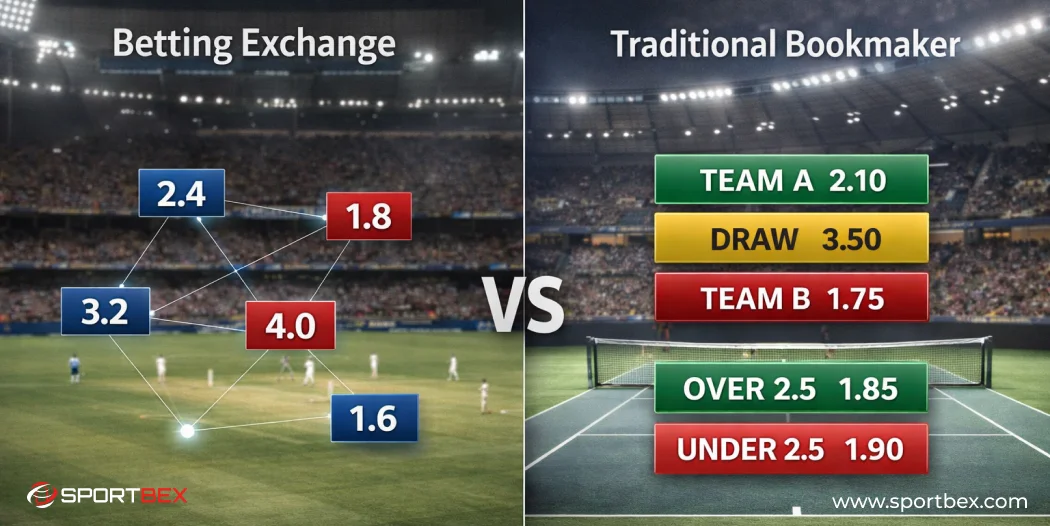
Betfair Exchange Odds work differently from traditional sportsbooks because you are not betting against a bookmaker or betting company. Instead, you are placing bets against other users on a peer-to-peer betting exchange platform. This creates a market-based system where prices are driven by user demand rather than fixed by the house.
One user places a back bet on an outcome, while another user takes the opposite position through a lay bet. Because the exchange operates as a marketplace, the odds often reflect real market value and can be more competitive than standard bookmaker prices.
Instead of building a profit margin directly into the odds, the platform typically charges a small commission on net winnings. For anyone doing a serious betting odds comparison, Betfair Exchange Odds often provide better value, especially in high-liquidity sports such as Betfair API for Cricket, football and tennis.
What Are Traditional Bookmaker Odds?
Traditional bookmaker odds are the standard prices offered by sportsbooks and online betting platforms. When you place a bet with a bookmaker, you are betting directly against the house and the bookmaker is responsible for setting the odds for each market.
These odds are usually based on probability models, historical match data, market trends and risk management strategies. The bookmaker carefully adjusts prices to balance betting activity and reduce exposure on one side of the market.
During a bookmaker odds comparison, these odds are often lower than exchange prices because the margin is already included within the payout structure. This difference is one of the key reasons why Betfair Exchange vs Traditional Bookmaker Odds remains an important comparison for value-focused bettors.
Betfair Exchange vs Traditional Bookmaker Odds (Detailed Comparison)
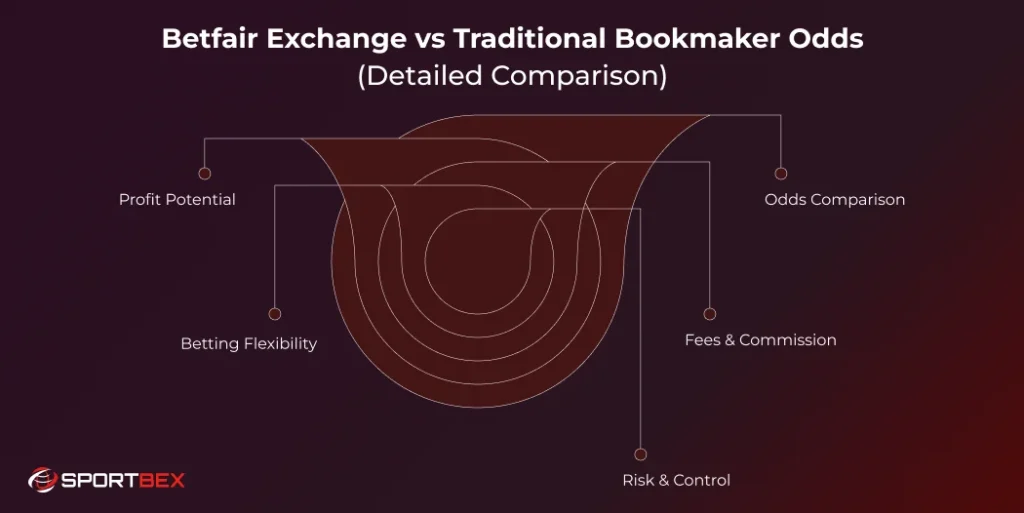
Let’s break down the differences between a betting exchange like Betfair and a traditional bookmaker. When you see them side-by-side, the advantages become crystal clear!
| Feature | Betfair Exchange | Traditional Bookmaker |
|---|---|---|
| Odds | Almost always better! Since there’s no built-in house margin, the prices reflect the true market probability. It’s amazing to see the real numbers. | Odds are lower because they include a built-in profit margin for the bookie. This “overround” means you get less value on your bets. |
| Profit Potential | Your profit potential is generally higher. Because the odds are better, your long-term returns can be significantly larger! More cash in your pocket is always a win! | Your profit is capped by the lower odds offered. The bookmaker’s margin eats into your potential winnings over time. |
| Fees & Commission | Totally transparent! They offer fantastic prices and charge a small, flat commission (usually 2-5%) but only when you win. I love knowing exactly what I’m paying! | The fees are hidden inside the odds. You never see a separate charge, but you’re paying for it through lower payouts on every single winning bet. |
| Betting Flexibility | This is where the exchange truly shines! You can “lay” a bet, which means betting on something not to happen. You get to act as the bookie, how cool is that?! | You can only “back” an outcome, meaning you bet on something to happen. The options are much more limited. |
| Risk & Control | You have so much more control! You can trade your positions in real-time during an event, which allows you to lock in a profit or cut your losses before it even ends. | Your risk is fixed. Once you place your bet, you just have to wait and hope for the best. There’s no way to adjust your position once the bet is on. |
Betfair Exchange Pros and Cons
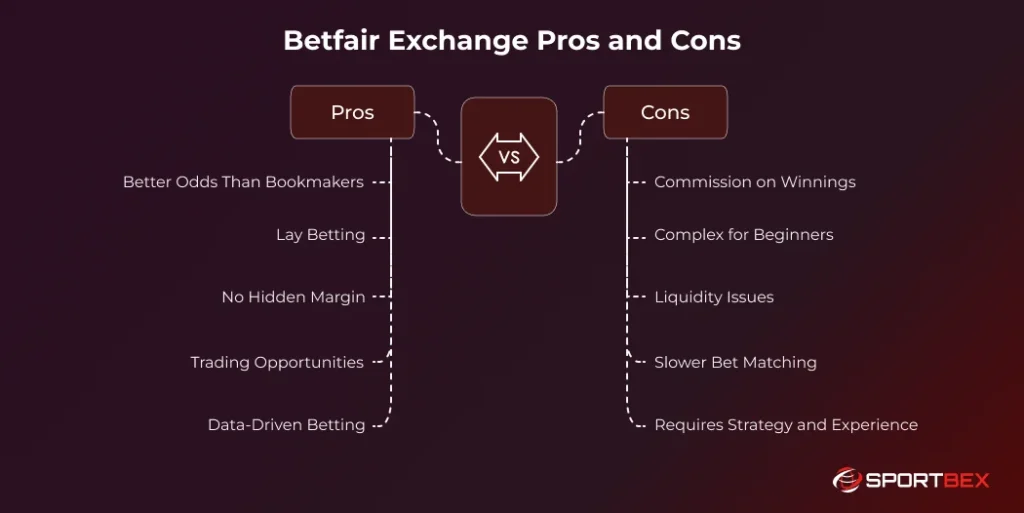
The Betfair vs Bookmakers difference is important before deciding where to place your bets. While betting exchanges often offer better value and flexibility, traditional bookmakers may be easier and more convenient for many users.
Pros of Betfair Exchange
Better Odds Than Bookmakers
One of the biggest advantages of Betfair Exchange Odds is the better pricing compared to traditional sportsbooks. Since there is no built-in house margin, the odds usually reflect true market value, which means bettors often receive higher returns on successful wagers. As highlighted in any detailed betting odds comparison, even a small improvement in odds can make a significant difference to long-term profitability.
Lay Betting
Lay betting is one of the most unique and valuable features of a betting exchange. Instead of only backing an outcome to happen, you can also bet on something not happening, which gives you much greater strategic control. This flexibility is especially useful for experienced users who want to hedge positions, trade live markets or take advantage of overvalued favorites.
No Hidden Margin
Another major benefit is pricing transparency. Unlike traditional bookmakers, the exchange does not hide fees inside the odds through an overround margin. What you see is the actual market-driven price, with only a clearly stated commission charged on winnings, making it easier to understand your true returns and compare value accurately.
Trading Opportunities
A betting exchange allows you to treat sports betting more like financial trading. Users can back at one price and lay at another as the odds move, which creates opportunities to lock in profit regardless of the final result. This feature is especially popular in live betting markets where odds change quickly throughout the event.
Data-Driven Betting
Exchange platforms are well-suited for data-focused bettors who prefer to make decisions based on market movement and liquidity trends. By analyzing money flow, price changes and volume patterns, users can make more informed betting decisions. Many advanced bettors also rely on live sports odds accuracy and exchange data to improve their strategies.
Cons of Betfair Exchange
Commission on Winnings
Although the odds are generally better, the exchange charges a commission on net winnings, usually between 2% and 5%. While this is often still more profitable than bookmaker margins, it does require users to factor the fee into their expected returns, especially when making frequent or high-volume bets.
Complex for Beginners
For new bettors, the exchange interface can feel more technical than a traditional sportsbook. Features such as lay betting, liability calculations and market depth may take time to understand. This makes the platform slightly less beginner-friendly, especially for users who are only familiar with fixed-odds betting.
Liquidity Issues
Liquidity can sometimes be a challenge, particularly in smaller sports, niche leagues or low-interest events. If there are not enough users willing to take the opposite side of your bet, your wager may remain unmatched. This is one area where traditional bookmakers often provide a smoother experience.
Slower Bet Matching
Because bets need another user to match them, placement is not always instant. In fast-moving live markets, even a slight delay can affect the available price. This is why real-time sports odds updates and quick market reactions are especially important for exchange users.
Requires Strategy and Experience
To fully benefit from Betfair Exchange vs Traditional Bookmaker Odds, users need a stronger understanding of betting markets and price movement. It is not simply a place to place quick bets; instead, it rewards strategic thinking, market analysis and long-term value betting.
Traditional Bookmaker Pros & Cons
Traditional sportsbooks remain popular because of their simplicity, speed and user-friendly design. For many casual bettors, they offer a more straightforward experience compared to exchanges.
Pros of Traditional Bookmakers
Easy to Use
Traditional sportsbooks are designed for simplicity and convenience. Users can quickly log in, choose a market, enter a stake and place a bet within seconds. This straightforward process makes them ideal for casual bettors and those who prefer a hassle-free experience.
Fixed Odds Betting
One of the biggest advantages is that your payout is locked in the moment the bet is placed. There is no need to wait for another user to match the bet and the return amount is clearly shown before confirmation, giving bettors certainty and speed.
Bonuses & Promotions
Bookmakers frequently offer welcome bonuses, free bets, enhanced odds and loyalty rewards. These promotions can add extra value, especially for new users and are often a key reason many bettors choose sportsbooks over exchanges.
Instant Bet Acceptance
Bets are accepted immediately by the house. There is no waiting for liquidity or market matching, which makes the process much faster, especially during live betting or high-pressure situations.
Wide Market Availability
Traditional bookmakers usually cover a broad range of sports and events, from major football leagues to niche sports like table tennis and esports. Supported by a live odds data provider, they can offer thousands of markets across different competitions.
Cons of Traditional Bookmakers
Lower Odds
A major drawback is that bookmaker odds are generally lower due to the built-in margin. During a bookmaker odds comparison, this reduced pricing often results in lower long-term returns compared to exchange betting.
No Lay Betting Option
Traditional sportsbooks only allow users to bet on outcomes, which limits strategic flexibility. Bettors cannot directly bet against an event outcome, making advanced trading strategies impossible.
Account Limitations & Restrictions
Successful bettors may face account limitations, stake reductions or even restrictions if they consistently beat the market. This is a common issue for professional or high-performing users.
Less Control Over Odds
Since the bookmaker controls the pricing, bettors have little influence over the available odds. Prices can change quickly and users often need to act fast to secure the best number before the line moves.
Hidden Margins
The bookmaker’s profit margin is already included within the odds, which means the cost is not always visible to the user. While convenient, this often reduces overall value compared to Betfair Exchange Odds.
Which One Should You Choose: Betfair Exchange or a Traditional Bookmaker?
The choice between a betting exchange and a traditional bookmaker depends entirely on your betting goals and experience level. If you prefer a simple interface, instant bet acceptance and attractive promotional offers, a traditional bookmaker is often the better option.
It is especially suitable for casual bettors who value convenience and ease of use over advanced trading features. If your focus is on finding the best value, accessing higher odds and using strategies such as lay betting or live trading, Betfair Exchange Odds may be the smarter choice.
Many experienced bettors use both platforms and rely on detailed betting odds comparison methods to place bets wherever the value is strongest, including markets like NBA betting odds revenue. Betfair Exchange vs Traditional Bookmaker Odds can help users make more informed betting decisions based on their goals.
Conclusion
When comparing Betfair Exchange vs Traditional Bookmaker Odds, the right choice depends on your betting style, experience, and long-term goals. Traditional bookmakers are often preferred by users who value simplicity, fast bet execution, and reliable market access, while platforms such as Sportbex free trial can help users evaluate features before making a long-term decision.
Betting exchanges are ideal for users seeking higher odds, greater flexibility, and advanced options such as lay betting or live trading. For regular betting odds comparison, Betfair Exchange Odds often deliver stronger long-term value through market-driven pricing.
Many experienced bettors use both platforms strategically to maximize returns. Comparing prices across bookmakers and exchange markets helps identify better value, while responsible betting and market understanding support stronger long-term results.
Get a Ready-Made Platform On Rent.
Get Started Today
Frequently Asked Questions
A betting exchange allows you to bet against other users, while a traditional bookmaker lets you bet against the house, which usually includes a built-in profit margin.
Yes, in many cases, Betfair Exchange Odds are often higher than bookmaker prices, which can lead to better returns even after deducting the exchange commission fee.
Comparing odds helps you secure the best possible payout for the same stake and even small price differences can improve your long-term betting profitability.
A betting exchange may seem complex initially because of features like lay betting and market matching, but it becomes easier once you understand how it works.
Commission is a small percentage fee charged by the exchange on your net winnings instead of adding a hidden margin within the odds, as bookmakers do.
Recent Blog



How to build a low-latency live sports streaming app using APIs
September 9, 2026
 12 min

Cricket API Uptime & Availability: What Developers Should Know
August 27, 2026
13 min
Access Real-Time Sports Odds and Boost Your Betting Platform
API Free Trial