Betfair Exchange API vs Traditional Bookmaker API: Which Fits Asian Market Operators?

April 6, 2026

10 min read
The Asian betting market is one of the fastest-growing in the world. Operators from Southeast Asia to South Asia are building platforms that handle massive volumes real-time data and a highly competitive audience.
When it comes to technology one question keeps coming up. Should you go with a Betfair Exchange API or stick with a Traditional Bookmaker API? Both options have their strengths and both have their limitations.
The right choice depends heavily on your business model, your target market and your technical capabilities. No two operators have the same needs and that is exactly why this comparison matters.
In this blog we break down the Betfair Exchange API vs Traditional Bookmaker API: Which Fits Asian Market Operators? clearly and honestly. If you are an Asian market operator trying to figure out which fits your platform best you are in the right place.
What is the Betfair Exchange API?
The Betfair Exchange API is a programming interface that allows operators and developers to connect directly to the Betfair betting exchange. Unlike a traditional sportsbook it works on a peer-to-peer model where bettors place bets against each other rather than the house.
For operators exploring a betting exchange api this is one of the most established and liquid options available globally. It gives you access to live markets real-time odds and the ability to place lay and back bets programmatically.
If you want to understand all available API Features Sports Betting solutions the exchange model offers a very different and more flexible experience compared to a standard bookmaker setup.
Key Features of Betfair Exchange API
- Real-time market data with live price updates
- Back and lay betting functionality for peer-to-peer wagering
- Streaming API for live odds and market changes
- REST and JSON-RPC based endpoints for easy integration
- Automated bot support for algorithmic trading
- Comprehensive documentation and developer resources
- Global liquidity pool across hundreds of sports and events
Betfair Exchange API Pros:
High Liquidity Markets
The Betfair Exchange API gives access to a deep and liquid global market. This means better odds, tighter spreads and faster bet matching across popular sports like cricket and football for your users.
Lower operator risk
Since bettors are matched against each other the operator is not exposed to the same level of liability as a traditional bookmaker. The platform earns through commission rather than taking a position on the outcome. This significantly lowers your financial risk as an operator.
Real-time trading opportunities
The api betfair exchange supports live in-play markets which means your users can trade positions during a match. This is a huge draw for the Asian market where live betting is extremely popular. Operators can offer a dynamic and engaging product without building the odds infrastructure from scratch.
Transparent Pricing
Because odds are set by the market and not the operator, pricing is transparent and fair. This builds trust with users especially in markets where bettors are sophisticated and price-sensitive. Asian bettors are very familiar with Sportsbooks Odds and they always look for the best value before placing a bet.
Scalable for large platforms
The Betfair Exchange API is built to handle high volumes. Whether you have thousands or millions of users the infrastructure can scale without performance issues. This is critical for operators targeting high-traffic Asian markets like India Indonesia or the Philippines.
Betfair Exchange API Cons:
Complex integration
Integrating the Betfair Exchange API is not a simple plug-and-play process. It requires experienced developers solid API knowledge and proper testing. For operators without a strong tech team this can be a significant barrier to entry. A proper Sportsbook API Integration plan is essential before you begin.
Commission-based earnings
While lower risk is a benefit the trade-off is that your earnings depend on commission volume. If your platform does not generate enough betting activity your revenue will be limited. High-volume operators benefit more from this model than smaller regional ones.
Requires technical expertise
From streaming APIs to bot management the technical demands are high. You will need developers who understand the Betfair Bookmaker API ecosystem and can manage ongoing maintenance updates and troubleshooting.
Limited control over odds
Since odds are market-driven you cannot set or adjust them manually. For operators who want full control over their product this is a real limitation. You are essentially a platform facilitating bets rather than a traditional bookmaker setting your own lines.
What is a Traditional Bookmaker API?
A Traditional Bookmaker API connects your platform to a bookmaker’s backend system. In this model the bookmaker sets the odds, manages the risk and you as the operator offer those odds to your users through your platform.
The Bookmaker API vs Exchange API difference is fundamental. In a traditional setup the house takes the other side of every bet. The operator earns through the margin built into the odds also known as the vig or juice. This is the classic model that most bettors around the world are familiar with.
While this is the classic model, many modern operators are now moving towards exchange models for better transparency and liquidity. However, managing an exchange requires a specialized Betfair Exchange API Provider like Sportbex to handle high-frequency data and peer-to-peer betting logic.
For operators who want to understand how to start a sportsbook the traditional bookmaker API is often the first model they explore because it is simpler to understand even if it comes with its own set of challenges.
Key Features of Bookmaker API:
- Pre-set odds managed by the bookmaker’s trading team
- Wide market coverage across sports leagues and events
- Risk management tools built into the platform
- Custom market creation for regional events
- White-label options for faster deployment
- Multiple sport coverage including Asian-specific sport like Football and cricket
- Live odds feeds with regular updates
Traditional Bookmaker API Pros:
Full Control Over Betting Markets:
With a traditional setup you decide which markets to offer and how to present them to your users. This level of control is valuable for operators building a brand in a specific region. You can tailor the product to your audience’s preferences without depending on market liquidity.
Higher profit margins
When managed well the traditional bookmaker model can generate strong margins. The built-in vig on every bet means revenue on every wager regardless of outcome. For operators with solid sportsbook risk management processes in place this model can be very profitable.
Easier business model
The concept is simple. Set odds, take bets and pay out winners. For operators who are new to the industry this model is easier to understand and explain to stakeholders and investors. There is a clear and established playbook to follow.
Better for regional operators
If you are targeting a specific country or region you can customize markets for local sports events and preferences. A Sports betting API built on the traditional model allows you to create hyper-local offerings that an exchange simply cannot replicate.
Custom market creation
Traditional bookmaker APIs allow you to create markets for niche events, local leagues and even non-sporting events. This flexibility is a major advantage in the Asian market where regional sports like Muay Thai sepak takraw and local cricket tournaments have a massive following.
Traditional Bookmaker API Cons:
Higher operational risk
When you take the other side of every bet you are exposed to liability. A big win or a series of winning bets can significantly impact your revenue. Without proper tools and processes your platform can take heavy losses.
Requires risk management team
You need experienced traders and risk managers to monitor markets, adjust odds and manage exposure. This is an ongoing cost that adds to your operational overhead. Operators who underestimate this often run into serious financial problems.
Liability exposure
Unlike the exchange model where risk is distributed among bettors, the traditional model puts you on the hook for every losing bet you have to pay. Managing this liability requires sophisticated tools and experienced staff especially during major sporting events.
Odds management complexity
Keeping odds competitive, accurate and profitable requires constant attention and effort. You need access to reliable Live Betting Odds API feeds and a team that can react quickly to market movements injuries and other factors that affect outcomes. This complexity grows with the size of your platform.
Betfair Exchange API vs Traditional Bookmaker API: Core Differences
| Feature | Betfair Exchange API | Traditional Bookmaker API |
|---|---|---|
| Market Model | Peer-to-Peer Exchange | User vs Bookmaker |
| Betting Options | Back (bet for outcome) and Lay (bet against outcome) | Back (bet for outcome) only |
| Odds Setting | Users and market demand set prices | Bookmaker sets odds and pricing |
| Liquidity | Provided by other users and matched in the market | Provided by bookmaker within risk limits |
| Revenue Source | Commission on net winnings | Margin built into betting odds |
| Data Delivery | Low latency JSON streaming and REST APIs | REST APIs and third party odds feeds |
| Account Limits | Winners are generally supported in the exchange model | Winning users may face stake limits based on risk policies |
| Market Depth | Shows available volume at different price levels | Shows limited odds and market availability |
Betfair Exchange API vs Traditional Bookmaker API: Use Case Comparison
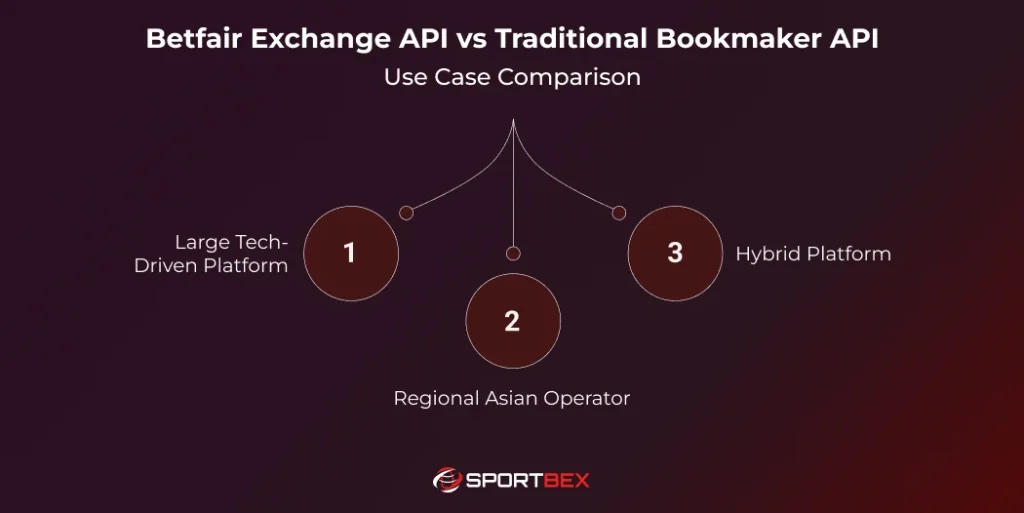
Large Tech-Driven Platform
If you are building a platform with algorithmic trading automated bots and a tech-first approach the Betfair Exchange API is clearly the better fit. You get global liquidity real-time data and lower operational risk.
Regional Asian Operator
If you are targeting a specific country like India, Vietnam or Thailand and want to offer localized markets with full control the Traditional Bookmaker API gives you more flexibility. You can build around regional preferences and sports.
Hybrid Platform
Some operators are now building hybrid models that use both APIs offering exchange-style betting for major global markets and traditional bookmaker markets for regional events. The role of ai in sports betting is growing in both models as AI tools are being used to manage odds, set risk limits and personalize the user experience.
Which API is Better for Asian Market Operators?
Honestly there is no single answer that fits every operator. It depends on your goals, your budget and your technical capabilities.
Choose Betfair Exchange API If:
- You are a well-funded operator with a strong tech team
- You want to compete on a global scale with access to Odds API for sports betting
- You prefer a lower risk commission-based model
- You want a powerful and scalable platform foundation
Choose Traditional Bookmaker API If:
- You are a regional operator focused on a specific Asian market
- You want full control over your odds and betting markets
- You need strong sportsbook risk management tools
- You want to build localized markets and grow at your own pace
Conclusion
Both the Betfair Exchange API and the Traditional Bookmaker API have a place in the Asian betting market. The exchange model offers transparency, lower risk and global liquidity. The traditional model offers control higher margins and better regional flexibility.
The right choice depends on your business goals, technical resources and overall market strategy. Know your market, understand your technical capabilities and choose the API that aligns with your long-term vision.
The Asian market is growing fast. The operators who succeed will be the ones who build smart, choose the right technology and stay ahead of what their users actually want.
Get a Ready-Made Platform On Rent.
Get Started Today
Frequently Asked Questions
The Betfair Exchange API is a developer interface that connects software directly to the Betfair exchange enabling automated betting live price streaming real-time market data access and the ability to place update or cancel bets programmatically.
When betting with a bookmaker you can only back a winner but a betting exchange allows users to both back and lay an outcome giving more flexibility and better control over betting decisions.
Traditional Bookmaker API is better for regional Asian operators as it offers full market control custom market creation localized sports coverage and higher profit margins for specific markets.
Yes, Betfair Exchange API supports live betting with real-time odds updates and fast market data. It helps operators deliver smooth in-play betting experiences with accurate and dynamic pricing.
Main advantages include high liquidity markets lower operator risk real-time trading opportunities transparent pricing and a scalable infrastructure suitable for large betting platforms.
Recent Blog



How to build a low-latency live sports streaming app using APIs
September 9, 2026
 12 min

Cricket API Uptime & Availability: What Developers Should Know
August 27, 2026
13 min
Boost your betting app with instant Sports API data feeds.
API Free Trial