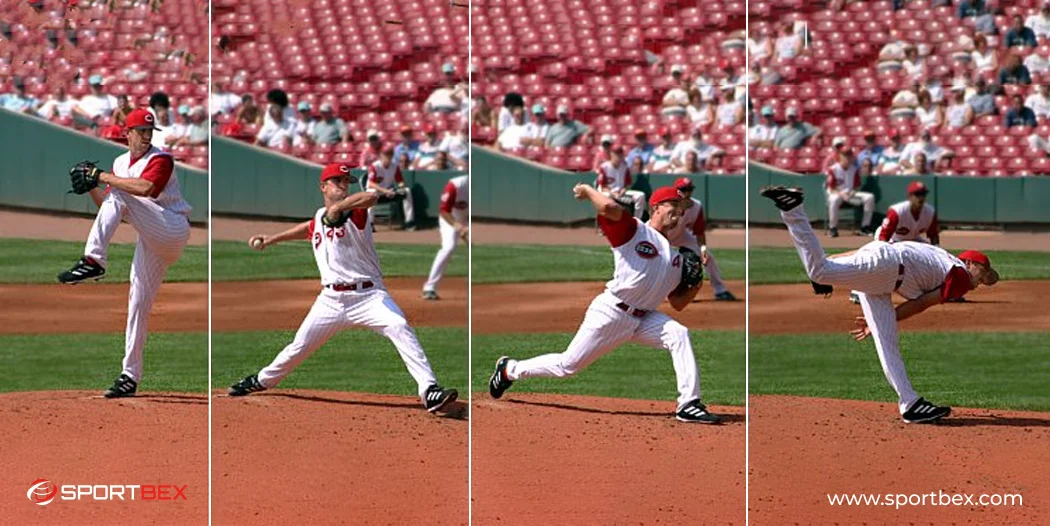
Standing on the mound takes more than strength. It requires control, awareness, and the ability to think ahead. Baseball Pitching is not just about throwing a ball. It is about reading the batter, adjusting strategy, and executing each throw with purpose.
A good pitcher understands timing and uses it to gain an advantage. When you look closely at pitching in baseball, you begin to see how much detail goes into every delivery. Speed, spin, and placement work together to shape each pitch.
The pitcher is constantly making decisions and trying to stay one step ahead. This makes pitching one of the most strategic aspects of the game. Even analysts and developers use tools like a Baseball Data API to study pitch patterns, speed variations, and player performance in real time.
If you want to understand the game truly, this guide on Baseball Pitching Explained: Fastballs, Curveballs and More will walk you through everything. From the basics to advanced concepts, you will learn how different techniques shape the outcome of every play. Mastering Baseball Pitching at any level starts with understanding these core principles.
What is Baseball Pitching?
At its simplest level, Baseball Pitching is the act of delivering the ball toward the batter to start a play. But in reality, it is much more complex. A pitcher must aim for accuracy, maintain balance, and control movement in every throw.
Great players build their reputation on consistency. Many of the Greatest Baseball Players became successful because they could repeat the same motion under pressure. Pitching in baseball depends heavily on mechanics.
A smooth and repeatable motion helps generate power while reducing the risk of injury. This consistency is what separates average players from experts in Baseball Pitching.
Types of Pitches in Baseball
To stay unpredictable, pitchers rely on different techniques. The types of pitches in baseball are designed to confuse hitters and control the pace of the game. A strong understanding of Baseball Pitching helps players use these variations more effectively in real match situations.
1. Fastballs (Speed-Based Pitches)
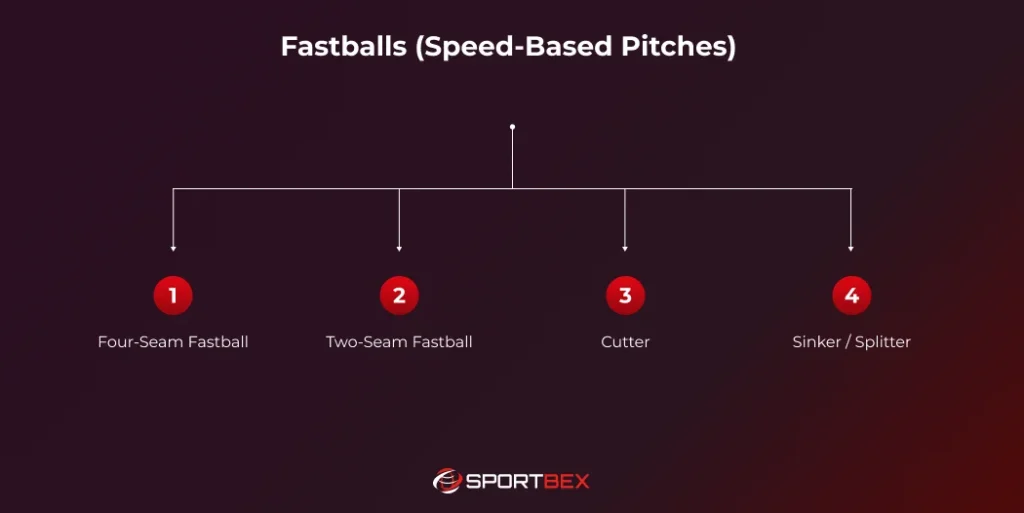
The fastball is the foundation of Baseball Pitching. It relies on raw velocity to overpower the hitter. A good fastball baseball pitch sets up the rest of a pitcher’s arsenal. Fans tracking Live MLB Scores API metrics often notice that the fastest pitches generate the most immediate excitement.
- Four-seam fastball: The fastest and straightest pitch. It cuts through the air with minimal movement, aiming to beat the batter with sheer speed.
- Two-seam fastball: Slightly slower than the four-seam, this pitch sinks and tails right before it reaches the plate, often resulting in ground balls.
- Cutter: A fastball that breaks slightly toward the pitcher’s glove side late in its trajectory.
- Sinker / Splitter: Thrown with a hard downward movement. The sinker drops dramatically, while the splitter (split-finger fastball) tumbles downward as it nears home plate.
2. Breaking Balls (Movement-Based Pitches)
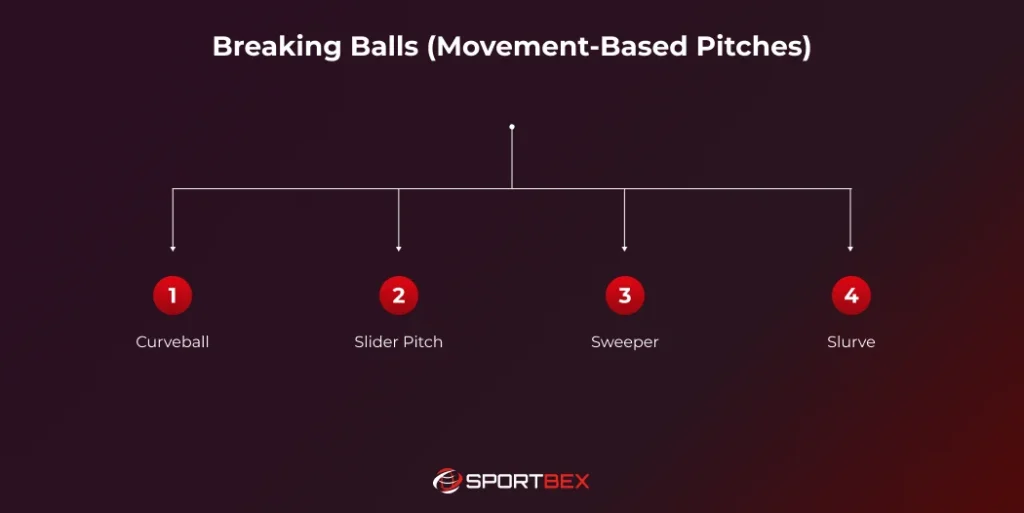
Breaking balls rely on spin to change direction mid-flight. A well-executed baseball curveball can make even the best hitters swing at thin air. Developers using Baseball API Providers often track spin rates to analyze the effectiveness of these breaking pitches.
- Curveball: Known for its pronounced top-to-bottom drop. The forward spin forces the ball downward.
- Slider Pitch: Faster than a curveball but with a sharper, lateral break. It looks like a fastball before darting away.
- Sweeper: A variation of the slider with massive horizontal movement and less downward drop.
- Slurve: A hybrid pitch combining the speed of a slider with the looping break of a curveball.
3. Off-Speed Pitches (Timing Disruption)
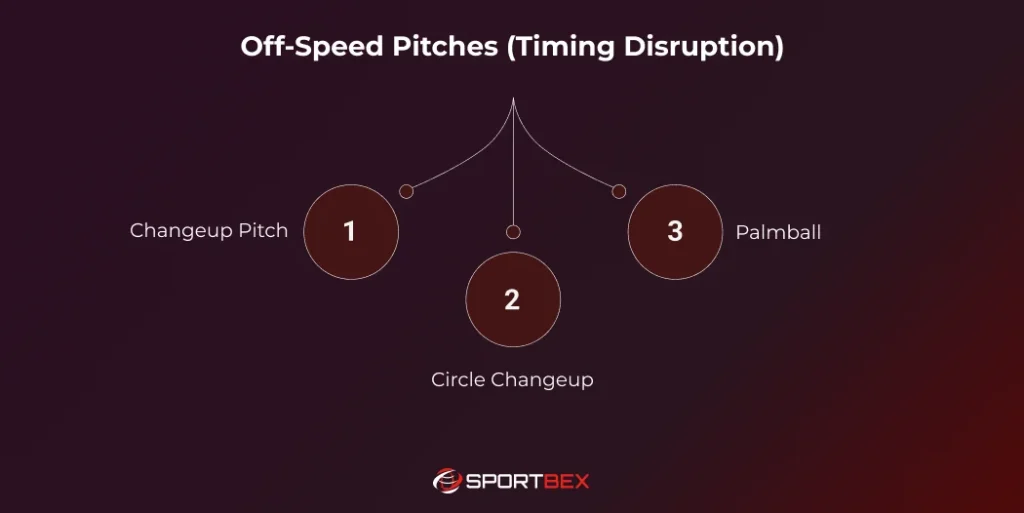
Off-speed pitches are designed to look exactly like fastballs but arrive much slower. This ruins the batter’s timing. Analysts working on Baseball Data Integration look closely at the speed differential between a pitcher’s fastball and their off-speed pitches.
- Changeup Pitch: Thrown with fastball mechanics but significantly slower due to grip.
- Circle Changeup: Uses a special finger position to create fading movement away from the hitter.
- Palmball: Held deep in the palm to reduce speed and create a softer, floating motion.
4. Specialty & Rare Pitches

These are unconventional pitches that few can master. They add a layer of unpredictability. Fans analyzing Baseball API Data rarely see these, but when they do, it is a spectacle.
- Knuckleball: Gripped with the fingertips or knuckles, it is thrown with almost zero spin, causing it to flutter unpredictably.
- Screwball: Breaks in the opposite direction of a standard curveball. It is extremely rare due to the awkward arm motion required.
- Eephus: An incredibly slow, high-arcing pitch meant to completely catch the batter off guard.
Easy-to-Integrate Baseball API
Get up and running in minutes with our clear documentation and simple API.
Baseball Pitch Grips Explained
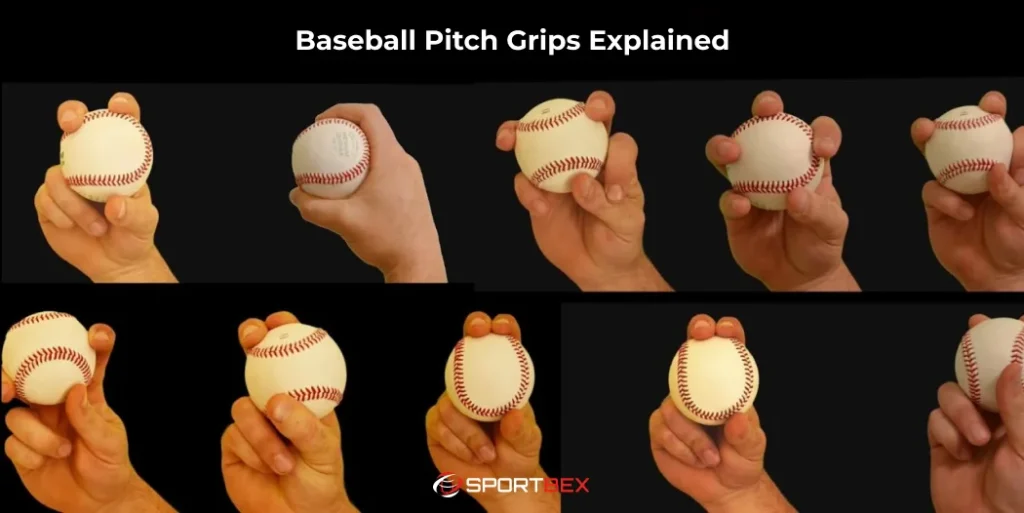
Execution starts with the fingers. The way a player holds the ball dictates its spin and trajectory. Mastering baseball pitch grips is essential for anyone looking to improve. Let’s look at the primary grips used across the Baseball Leagues List.
- Four-Seam Fastball Grip: Place your index and middle fingers across the wide seams of the ball. Keep your thumb underneath for support. This grip creates strong backspin, allowing the ball to travel straight with high speed. It is the most common grip used for a fastball baseball throw.
- Two-Seam Fastball Grip: Hold the ball along the narrow seams with your fingers placed close together. This grip produces less backspin and adds natural movement. The ball often sinks or tails slightly, making it more difficult for the batter to hit cleanly.
- Curveball Grip: Position your middle finger along the seam and apply pressure while releasing the ball. Snap your wrist downward to generate topspin. This grip is essential for creating the sharp drop seen in a baseball curveball.
- Slider Grip: Grip the ball slightly off center and apply pressure with your index finger. This creates tight spin and a late breaking motion. The slider is effective for producing sharp sideways movement near the plate.
- Splitter: Spread your index and middle fingers wider apart on the ball. This grip reduces spin and causes the ball to drop suddenly as it approaches the batter. It often looks like a fastball before falling quickly.
- Sweeper: Use a relaxed grip with fingers slightly off center. This allows the ball to move more horizontally across the plate. The sweeper focuses on wide lateral movement rather than a downward drop.
- Cutter Grip: Start with a four seam grip and shift your fingers slightly to one side. Apply extra pressure with the middle finger. This creates a late cutting action that moves away from the hitter at the last moment.
- Knuckleball Grip: Press your fingertips or nails into the ball and push it forward with minimal spin. This grip removes rotation, causing unpredictable movement in the air. It is difficult to control but can be very effective when mastered.
Fastball vs Curveball vs Slider vs Changeup
To understand the core types of pitches in baseball, comparing their speeds and movements is helpful. Fans who rely on Baseball Data for Fantasy League decisions study these metrics to predict pitcher performance.
| Pitch Type | Speed Range (mph) | Movement |
|---|---|---|
| Four-Seam Fastball | 90 – 100+ | Straight, high velocity, appears to rise |
| Curveball | 70 – 85 | Looping top-to-bottom drop |
| Slider | 80 – 90 | Sharp lateral break, slight downward drop |
| Changeup | 75 – 88 | Straight or fading action, significantly slower |
When to Use Each Pitch in a Game
Strategy plays a major role in Baseball Pitching. A pitcher must mix different options to stay unpredictable.
Those analyzing Accurate Baseball Betting Data often look at pitch selection patterns to understand outcomes.
- Fastballs are useful early in the count
- Curveballs help force weak swings
- Sliders work well for strikeouts
- Changeups are effective against aggressive hitters
Pitching in baseball is about reading the situation and adjusting quickly. A smart pitcher never becomes predictable. This is where advanced Baseball Pitching skills make a clear difference during competitive games.
Common Pitching Mistakes and How to Avoid Them
Even experienced players make errors. Identifying mistakes early can improve performance. One major issue is tipping pitches. This happens when the batter can see the grip before the throw. Keeping baseball pitch grips hidden is essential.
Another mistake is overthinking. Trying too hard to control the ball can reduce natural movement. Instead, focus on smooth mechanics.
For those exploring how to bet on Baseball, inconsistent pitchers are often considered risky because they lack control and predictability.
Conclusion
Baseball Pitching is a combination of skill, strategy, and control. From fastballs to breaking pitches, each technique serves a purpose. Understanding how these pitches work helps players improve and allows fans to appreciate the game on a deeper level.
By practicing proper mechanics, learning different pitch types, and applying smart strategies, pitchers can take their performance to the next level. Whether you are a beginner or someone analyzing games, mastering pitching in baseball opens the door to a better understanding of the sport.
Baseball Data That's Always Accurate
Deliver real-time, low-latency data to always stay ahead of the action.
Frequently Asked Questions
The four-seam fastball is the most crucial pitch. It establishes your baseline velocity and control, making all other types of pitches in baseball much more effective.
A changeup is tough to hit because it looks exactly like a fastball coming out of the hand. The batter begins their swing early, only to realize the ball is traveling much slower, throwing off their timing completely.
A curveball has a big, looping break with significant downward movement, achieved with a topspin rotation. A slider is faster and has a sharper, more horizontal break. It's more of a late, quick dart than a slow loop.
To prevent tipping, practice taking your pitch grips deep inside your glove. Keep your windup and arm speed identical for every pitch, whether you are throwing a heater or a curveball.
It can if done incorrectly. Poor mechanics and overuse lead to injuries. Maintaining proper form, following pitch count guidelines, and allowing adequate rest are essential for protecting your arm during your pitching career.
Recent Blog



How to build a low-latency live sports streaming app using APIs
September 9, 2026
 12 min

Cricket API Uptime & Availability: What Developers Should Know
August 27, 2026
13 min
Deliver Live Baseball Stats and Scores for Your Users
API Free Trial