What Are the Key Challenges for Sports Betting Software Developers?

April 14, 2026

9 min read

The sports betting industry is growing at a massive speed. Every day, millions of users place bets on live matches, tournaments and sporting events from their phones and computers. Behind every smooth betting experience is a team of skilled Sports Betting Software Developers working hard to make it all happen.
But building a sports betting platform is not like building a regular app. It involves technical, legal and performance challenges that most developers do not face. In sports betting software development, developers must handle millions of users while following strict gambling laws.
The demand for experienced Sports Betting Software Developers is rising faster than ever. Businesses across the world are investing heavily in online betting platforms, and they need developers who can handle real time systems, security, compliance and performance all at the same time.
In this blog, we cover What Are the Key Challenges for Sports Betting Software Developers? so whether you are a developer or a business owner planning to enter this space, this guide is for you.
What is sports betting software development?
Sports betting software development is the process of creating digital platforms such as websites, mobile apps and kiosks that enable users to wager on sporting events. It involves building secure, real time systems that handle everything from odds management and live betting to payment processing and risk management.
These platforms are specially designed for sportsbooks and operators who need reliable, fast and legally compliant technology. A good Sports Betting Software Development Company understands that this is not just about writing code, it is about building a complete ecosystem that works smoothly 24 by 7 for millions of users around the world.
From live score updates and real time odds to secure payment flows and compliance tools, every part of a betting platform needs to work perfectly together. That is why sports betting software development is considered one of the most technically challenging fields in the entire software industry.
Key Challenges Faced by Sports Betting Software Developers
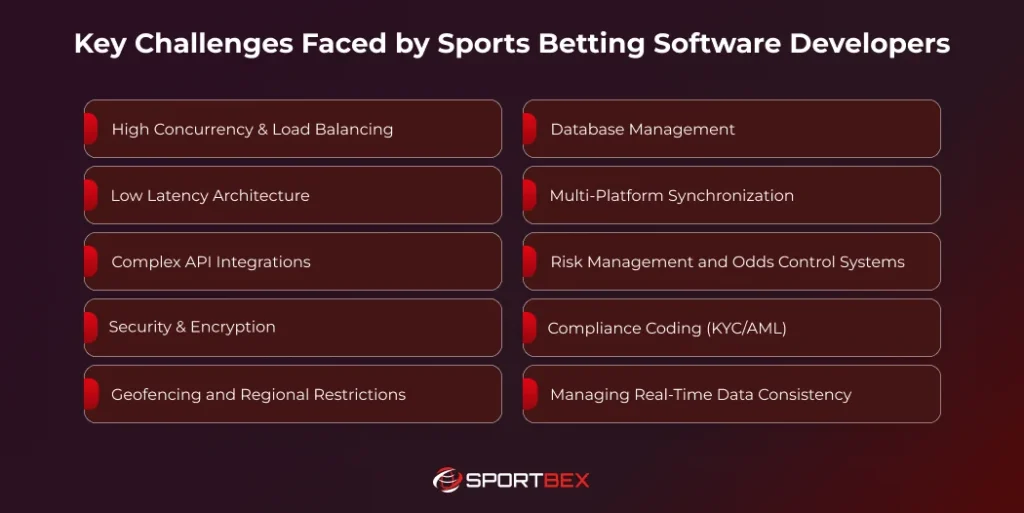
Sports betting platforms are highly complex systems that require real time performance, strong security and smooth user experience at all times. Sports Betting Software Developers face many technical and operational challenges while building these platforms to ensure everything runs fast, accurate and without downtime.
1. High Concurrency & Load Balancing
Sports betting software developers must handle thousands, sometimes millions, of users placing bets at the same time. During major live events like the World Cup or Super Bowl, traffic spikes are massive and unpredictable. If the system is not built to handle this load, the platform may crash at the worst possible moment.
Key Stats:
- Major sporting events can generate millions of simultaneous requests on betting platforms
- Most users do not return after a poor performance experience
Solution:
Developers implement auto-scaling cloud infrastructure, load balancers, and distributed server architecture to evenly distribute traffic. Regular load testing before big events is also essential to ensure system stability.
2. Low Latency Architecture
In sports betting, every millisecond matters. If odds change during a live match and the platform takes even a second to update, users could place bets on outdated information. That leads to financial losses and user frustration. Sports Betting Software Developers must design sports betting software architecture that delivers data in real time with minimum delay.
Key Stats:
- A delay of even 300 milliseconds in odds update can result in thousands of incorrect bets being placed.
- Platforms with low latency architecture see 40% higher user retention compared to slower competitors.
Solution: Developers must use WebSockets, event-driven systems and optimized server communication to keep data flowing instantly. Choosing the right tech stack and conducting constant performance testing is essential to maintain lightning-fast speed.
3. Complex API Integrations
A sports betting platform does not work alone. It depends on dozens of third-party services, such as sports data providers, odds feeds, payment gateways, identity verification tools and more. Managing all these integrations, handling API errors gracefully, and keeping data consistent is one of the most technically demanding parts of sports betting software development.
Key Stats:
- A typical sports betting platform integrates with 15 to 30 third-party APIs at the same time.
- API failures are responsible for nearly 60% of platform downtime in live betting environments.
Solution: Developers must use API management tools, build proper error handling systems and always have fallback mechanisms ready. Regular API monitoring and testing ensures the platform stays stable even when one service goes down.
4. Security & Encryption
A sports betting platform handles real money, personal data and sensitive financial transactions every single second. Any security weakness can be exploited by hackers, leading to massive data breaches and financial losses. Developers must write code that protects every layer of the platform from user login to payment processing.
Key Stats:
- The online gambling industry loses over $1 billion annually due to cyber attacks and fraud.
- Platforms without proper encryption are 3x more likely to experience a data breach.
Solution:Developers must implement SSL/TLS encryption, two-factor authentication, secure payment flows and regular security audits. Staying updated with the latest security standards and best practices is not optional; it is a core responsibility of every developer working in this space.
5. Geofencing and Regional Restrictions
Sports betting laws vary by country and even by state, making geofencing one of the hardest problems developers face. They must build GPS-based systems to detect user locations, block restricted regions and handle VPNs and location spoofing. One wrong move can lead to serious legal consequences.
Key Stats:
- Over 85 countries have different and conflicting sports betting laws that developers must code for.
- Geofencing errors have resulted in fines of up to $5 million for some betting operators.
Solution: Developers must use accurate GPS and IP-based geofencing tools, build VPN detection systems, and regularly update location restriction logic whenever new laws come into effect in any region.
6. Database Management
A sports betting platform generates an enormous amount of data every second, including bets placed, odds updated, match scores, user activity, transactions and more. Sports Betting Software Developers must design database systems that can read and write data extremely fast without any lag. Poor database management leads to slow performance, data errors and even data loss, directly impacting users and the business.
Key Stats:
- A busy betting platform can generate over 1 million database transactions per minute during live events.
- Poor database performance is responsible for 70% of slow-loading betting platforms worldwide.
Solution: Developers must choose the right database technology, optimize queries, use caching systems, and plan for data growth over time. A well-designed database is the backbone of every fast and reliable betting platform.
7. Multi-Platform Synchronization
Users bet on multiple devices: smartphones, tablets, laptops, and desktops and every platform behaves differently. Keeping the Sports Betting App and web platform in perfect sync while maintaining speed and accuracy requires strong architecture and careful coding. Any mismatch in data between platforms can cause serious user trust issues.
Key Stats:
- Over 64% of all sports bets are now placed on mobile devices globally.
- Platforms with poor cross-device sync experience 35% higher user drop-off rates compared to well-synced platforms.
Solution: Developers must build a unified backend that serves consistent data to all platforms simultaneously. Using real-time sync technologies and thorough cross-platform testing before every release is essential.
8. Risk Management and Odds Control Systems
Sports Betting Software Developers must integrate AI in Sports Betting to create smart risk management systems. These systems track betting patterns, control odds and detect suspicious behavior in real time. AI helps prevent exploitation and protect against financial losses, requiring expertise in data science, machine learning and betting market dynamics.
Key Stats:
- The global sports betting industry loses an estimated $1.7 billion annually due to fraud and odds exploitation.
- Platforms with automated risk management tools reduce fraud-related losses by up to 60%.
Solution: Developers must integrate machine learning models, real-time alert systems, and automated odds control logic into the platform. Continuous monitoring and regular model updates are essential to stay ahead of fraudsters.
9. Compliance Coding (KYC/AML)
Legal compliance is one of the most critical challenges in building betting platforms. Sports Betting Software Developers must ensure that the platform follows strict regulations that vary across different countries and regions. Failure to comply can lead to heavy penalties or even platform shutdown.
Key Stats:
- Betting platforms must comply with multiple regional and international regulations
- Non-compliance can result in heavy fines and legal actions
Solution:
Developers implement strong KYC (Know Your Customer) and AML (Anti-Money Laundering) systems to verify user identity and monitor suspicious activities. Regular updates and audits are essential to stay aligned with changing regulations.
10. Managing Real-Time Data Consistency
In sports betting platforms, data consistency is extremely important. Odds, scores, match status and bet results must stay perfectly in sync across all users, devices and regions in real time.
Key Stats:
- Even a few seconds of incorrect data can lead to wrong bets and disputes
- Thousands of users interact with the same data simultaneously during live events
Solution:
Sports Betting Software Developers working on Online Sports Betting Software use real-time data processing systems, event streaming, and synchronization techniques to ensure data accuracy across the platform. Continuous monitoring and quick error handling are also essential to maintain consistency.
Why Developers Trust Sportbex for Sports Betting Solutions
Many Sports Betting Software Developers prefer working with reliable platforms that reduce complexity and speed up development. Building a complete betting system from scratch can be time-consuming and technically challenging. That is why developers look for solutions that offer stability, performance and ready-to-use features without compromising quality.
Sportbex provides a strong foundation that helps developers handle critical areas like real-time data, system performance and security with ease. Instead of managing complex backend systems, developers can focus more on improving user experience, adding new features and scaling their platforms efficiently.
Key Benefits:
- Stable and scalable infrastructure for high traffic events
- Fast and reliable APIs for real-time data integration
- Advanced security systems to protect user data and transactions
- Easy integration with existing platforms and tools
By using modern tools and a well-designed architecture, Sportbex helps developers overcome common challenges in building modern betting platforms. It also acts as a practical sports betting software development guide for teams looking to build scalable, secure and high-performance betting platforms.
Conclusion
Being a sports betting software developer is one of the most demanding jobs in the tech world. The combination of real time performance, strict security, complex regulations and high user expectations makes this field truly challenging.
From managing high concurrency and low latency to writing compliance code and building risk management systems, Sports Betting Software Developers must master a wide range of technical skills just to keep a platform running smoothly.
Understanding these challenges is the first step toward solving them. Whether you are a developer entering this space or a business planning to build a betting platform, knowing what is involved in sports betting software development helps you plan better and build smarter.
Get a Ready-Made Platform On Rent.
Get Started Today
Frequently Asked Questions
Sports Betting Software Developers face challenges like handling high traffic, real time data updates, security risks, API integration and legal compliance while ensuring smooth and fast platform performance.
Sports betting software development is the process of creating digital platforms, websites and mobile apps that enable users to place wagers on sporting events while allowing operators to manage odds, risks and user accounts.
Developers use load balancing, cloud infrastructure, and auto scaling systems to manage high traffic. This helps platforms stay stable and perform well during major sports events.
KYC and AML systems help verify user identity and prevent illegal activities. Developers must implement these systems correctly to ensure compliance with legal regulations.
Security challenges include protecting user data, preventing fraud and securing transactions. Developers use encryption, monitoring tools and authentication systems to reduce risks.
Recent Blog



How to build a low-latency live sports streaming app using APIs
September 9, 2026
 12 min

Cricket API Uptime & Availability: What Developers Should Know
August 27, 2026
13 min
Launch Your Betting Platform Quickly and Securely
API Free Trial